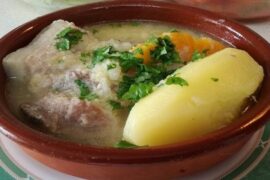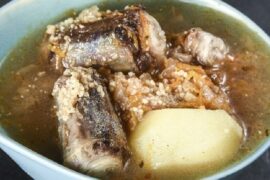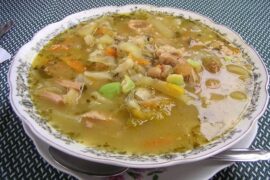
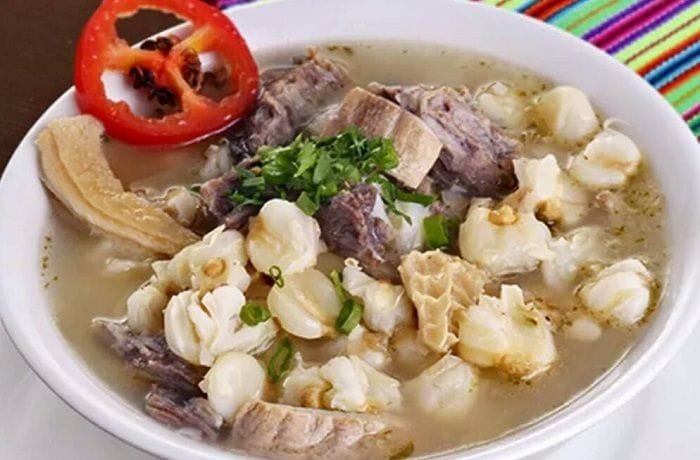
Peruvian caldo de mote is a hearty Andean soup made by simmering sheep’s head and tripe with mint, celery, onion, scallions, and garlic for two hours, then adding rice, potatoes, and cooked hominy (mote), served very hot with ground oregano. It takes 20 minutes of preparation plus 150 minutes of cooking and serves 4 people.
It is a comforting classic of Peruvian cooking, ideal for fighting the cold of the highlands.
How to Make Peruvian Caldo de Mote?
Caldo de mote, or sopa de mote, is made with hominy corn and mutton, cooked slowly to draw out all the concentrated flavor of the ingredients. The meat is simmered first with herbs and vegetables, and the starches are added in stages at the end.
Nutritional Information
Each serving of caldo de mote contains approximately 400 kcal, 50 g of carbohydrates, 12 g of fat, 20 g of protein, 5 g of fiber, 2 g of sugars, 80 mg of cholesterol, and 700 mg of sodium. These values are estimates and may vary depending on ingredients and portion sizes.
Homemade Peruvian Caldo de Mote Recipe
Preparation: 20 minutes
Cooking: 150 minutes
Servings: 4 people
Ingredients
- 750 g (1.7 lb) of cooked hominy (mote)
- 750 g (1.7 lb) of sheep’s head, cut into pieces
- 250 g (9 oz) of sheep tripe
- 3 tablespoons of rice
- 2 large potatoes
- 2 celery stalks
- 2 scallions
- 1 onion
- 1 tablespoon of ground garlic
- Fresh mint sprigs
- Ground oregano
- Fine salt

Instructions
- Fill a large pot halfway with water and bring it to a boil. Add the sheep’s head and tripe with a handful of mint sprigs, cover, and cook for 60 minutes. Add the celery, the onion cut into quarters, the roughly chopped scallions, and the ground garlic, and keep cooking for another 60 minutes.

- Add the rice and salt to taste, stir, and cook for 5 minutes. Add the peeled potatoes cut into cubes and cook for another 15 minutes, then add the cooked hominy and cook for 10 minutes more. Remove from the heat and serve right away, very hot, sprinkled with ground oregano.
Additional Tips
Sear the meat first
Browning the head and tripe briefly in a little oil before boiling gives the broth deeper flavor.
Add ají amarillo
For an authentic Andean touch and gentle heat, add slices of fresh ají amarillo in the last minutes or as a garnish.
Skim the broth
Remove the foam that rises during the first hour for a cleaner broth.
| Original ingredient | Substitute | Ratio | Flavor note |
|---|---|---|---|
| Sheep’s head and tripe | Lamb neck or shank | 1:1 | Milder, easier to find |
| Cooked hominy | Canned hominy, rinsed | 1:1 | Quicker |
| Fresh mint | Huacatay (black mint) | Half the amount | More Peruvian, stronger |
| Rice | Omit | Thinner broth |
Frequently Asked Questions (FAQs)
1. What is mote in Peru?
In Peru, mote is dried corn kernels cooked until soft, similar to hominy, unlike Chilean mote, which is hulled wheat.
2. Can I use lamb instead of mutton offal?
Yes. Lamb neck or shank works well and gives a milder broth.
3. How long does it keep?
Up to 3 days in the refrigerator; reheat it gently and add a little water if it has thickened.
4. What is it served with?
It is a complete meal on its own, sprinkled with oregano and, if you like, fresh chili.
What Is Caldo de Mote?
Caldo de mote is a Peruvian highland soup of hominy corn and mutton, simmered for hours with herbs and potatoes, eaten as a hearty meal in cold weather.
History of Caldo de Mote
The soup is related to patasca, a Quechua name for hominy soups from the Andes, which date back to pre-Hispanic times.
Did You Know?
Mote soups are not only Peruvian; Argentina, Bolivia, Chile, and Ecuador have their own local versions, each with its own ingredients.
How to adapt this recipe to a vegan or vegetarian version?
How to adapt this recipe to a gluten-free version?
How to adapt this recipe to a keto (ketogenic) version?
Recommended
- Traditional Atacama Patasca
- Chilean Calapurca Recipe
- Chilean Beef Foot Broth
- Traditional Mapuche Pisku Stew