
Merkén (also spelled Merquén or Meshken) is a Mapuche smoked chili seasoning made from cacho de cabra peppers, sea salt, and coriander seeds—ground to a coarse, flaky texture. Ready in 90 minutes, it yields 10 servings and keeps for up to 12 months in an airtight jar.
Nutritional Facts
Each serving of Mapuche merkén (20 g) contains approximately 45 kcal, 6 g of carbohydrates, 2 g of fats, 1 g of proteins, 2 g of fiber, 0 g of sugars, and 300 mg of sodium.
How to Make Mapuche Merkén
Its preparation is based on a mixture of dried and smoked “cacho de cabra” chili peppers, ground on stone with sea salt and coriander seeds, which provide a natural preservative effect.
Prep Time: 45 minutes
Cook Time: 45 minutes
Servings: 10
Ingredients
- 200 g of dried red chili peppers
- 75 g of coarse sea salt
- 50 g of coriander seeds
Instructions
- For homemade smoking, distribute the dried chilies on a metal kitchen tray. Place some native wood shavings at the bottom of the oven, turn the temperature to the maximum until the shavings begin to smoke, and then lower the temperature to the minimum and maintain it for 40 minutes, ensuring it does not burn.

- In a medium skillet, add coriander seeds and chilies without the stems, and heat over medium heat for a couple of minutes, stirring gently with a wooden spoon until the mixture produces an intense aroma. Remove from heat.
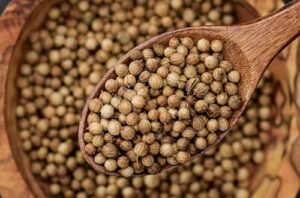
- In a large stone mortar, grind the chilies, salt, and coriander seeds until a coarse, flaky texture is achieved, never powdered. Another option is to use a food processor or a clean coffee grinder, always being careful not to grind too much. Cool and store the merkén in a cool, dry place until ready to use.
Additional Tips
- The most common mistake is grinding into a fine powder. Authentic merkén must have a coarse, flaky texture. Use the “pulse” setting for only 1–2 seconds at a time in a food processor or coffee grinder. Stop and check the texture frequently—once overground, it cannot be reversed.
- When smoking the chilies in your oven, use native, chemical-free wood shavings. You want a light, sweet, aromatic smoke — if it turns dark or acrid, vent the oven immediately to avoid a bitter flavor. The smoke phase should fill the oven with a gentle haze, not a thick cloud.
- Store in an airtight glass jar in a cool, dark, and dry place — never near the stove or in the refrigerator. Heat from cooking nearby causes clumping over time, and refrigerator moisture degrades the texture of the flakes. Label the jar with the production date. Its smoky aroma is most potent during the first 3 months and gradually mellows over the following 9 months.
| Application | Amount | Notes |
|---|---|---|
| Grilled meats (asado) | 1 tsp per steak | Rub in before grilling |
| Avocado / palta | Pinch to taste | Sprinkle directly on top |
| Soups and stews | ½ tsp per 4 servings | Add in the last 5 minutes |
| Olive oil dip | 1 tsp per 100 ml oil | Infuse for 30 minutes |
| Mantequilla merkén | 1 tsp per 50 g butter | Serve on bread or corn |
| Popcorn | ½ tsp per 3 cups | Add after popping |
Frequently Asked Questions (FAQs)
1. What does Merkén taste like?
It is a complex blend characterized by a deep smoky aroma, a moderate earthy heat from the Cacho de Cabra chili, and a bright, citrusy undertone provided by the roasted coriander seeds.
2. How spicy is Merkén?
On the Scoville scale, Merkén is considered mild to medium. It is significantly less spicy than cayenne pepper but has more “body” and lingering warmth due to the smoking process.
3. What is a good substitute for Merkén?
While its flavor is unique, you can approximate it by mixing smoked paprika (pimentón de la Vera) with a pinch of red chili flakes and a dash of ground coriander. However, it will lack the specific “Cacho de Cabra” earthiness.
4. How should I store my homemade Merkén?
Store it in an airtight glass jar in a cool, dark, and dry place. Because of the salt and the drying process, it can last for up to 12 months, though its smoky aroma is most potent during the first 6 months.
5. What are the best ways to use it?
It is incredibly versatile—in Chile, it’s used on grilled meats, fish, roasted vegetables, soups, fresh avocado, and even mixed into olive oil for dipping bread.
History of Merkén in Chile
Merkén has roots in pre-Columbian Mapuche culture, where the cacho de cabra chili was dried and smoked as part of traditional food preservation practices. The name derives from the Mapudungun expression “medkeñ chadi” (ground salt), reflecting that the original preparation was primarily a salted seasoning with chili added for flavor and preservation. After Spanish colonization in the 16th century, coriander seeds—brought from Europe—were incorporated and quickly adopted into Mapuche cooking, producing the three-component blend known today. Originating in the Araucanía Region, merkén spread throughout Chile and is now considered one of the symbols of 21st-century Chilean gastronomy. In 2010, it was registered as a Denomination of Origin product, recognizing its cultural and geographic roots in Mapuche territory.
Did You Know?
Originating in the Araucanía Region, its name comes from the Mapudungun expression “medkeñ chadi” (ground salt), as it was initially a seasoning made from crushed salt mixed with chili. Today, it is considered one of the symbols of 21st-century Chilean gastronomy.