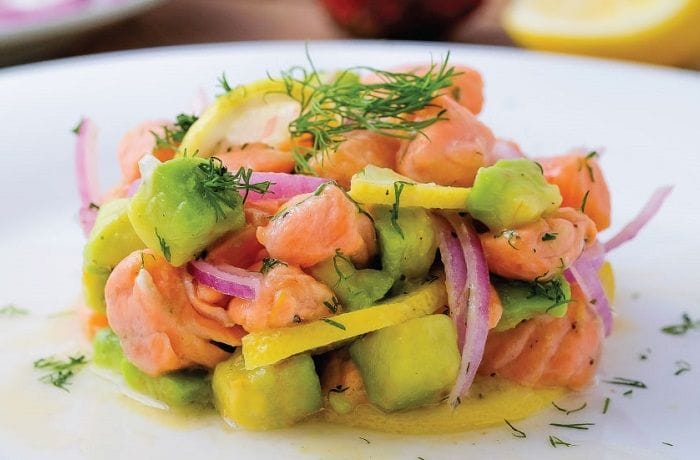
Chilean salmon ceviche with avocado is a fresh, vibrant appetizer — raw salmon cubed and marinated in Pica lemon juice, vegetable oil, garlic, and cilantro for 10 minutes, then finished with avocado, green chili, and bell pepper, ready in 15 minutes. Chile is the second largest salmon producer in the world, and this ceviche is considered one of the finest expressions of local gastronomy — two of the country’s best ingredients combined in a single preparation.
How to Make Salmon Ceviche?
The most important requirement for ceviche is salmon quality: always use fresh or completely thawed salmon — at least 24 hours outside the freezer in a standard refrigerator. The lemon acid in the marinade “cooks” the salmon’s exterior, but does not eliminate parasites in incompletely thawed or poor-quality fish. Cut the salmon into precise 1 to 1.5 cm cubes and marinate for no more than 10 minutes — longer exposure to acid breaks down the protein structure and produces a mushy texture.
Nutritional Information
Each serving of Chilean salmon ceviche with avocado contains approximately 400 calories, 12 g of carbohydrates, 24 g of fats, 32 g of protein, 5 g of fiber, and 600 mg of sodium.
Salmon Ceviche with Avocado Recipe
Preparation: 15 minutes
Servings: 6 people
Ingredients
- 1 kg of salmon fillet
- 60 ml of vegetable oil
- 4 Pica lemons
- 2 avocados, diced
- 1 red onion, sliced julienne
- 1 minced garlic clove
- 1 finely chopped green chili
- ½ bell pepper, diced
- ½ bunch of cilantro
- Lemon zest
- Fresh ginger
- Sea salt
- Pepper

Instructions
- Clean and cut the salmon fillet into 1 to 2 centimeter cubes, place in a large bowl, pour the vegetable oil, season with salt and pepper to taste, grate some ginger, mix everything and set aside.
- Cut the onion into very thin julienne and let it rest for about 3 minutes in a container with cold water and salt, then strain the water, add the minced garlic, mix to integrate and set aside.
- In a medium bowl, mix the lemon juice and vegetable oil, stir and set aside.
- In the bowl containing the salmon, add the onion and minced garlic, the lemon and oil mixture, mix everything, cover with plastic wrap and refrigerate for about 10 minutes.
- Serve the salmon ceviche immediately, complemented with the finely chopped green chili, bell pepper, avocado, and cilantro to taste.
Additional Tips
Degorge the red onion in cold salted water — removes sharpness without losing crunch
Red onion contains sulfurous compounds that give it a sharp, aggressive raw flavor that can overwhelm the delicate salmon. Soaking the julienned onion in cold salted water for 3 to 5 minutes draws out these compounds through osmosis while the cold water keeps the onion crisp. Drain thoroughly before adding to the ceviche. Do not soak for more than 10 minutes — over-soaking removes too much flavor and produces a watery, limp onion rather than a crisp, mild one.
Extract lemon juice without squeezing too hard — and avoid metallic contact
Pica lemons (limones de Pica) have thin skin and extremely aromatic juice that is more acidic than standard lemon varieties. Cut them into quarters rather than halves and apply gentle pressure when squeezing — overly forceful squeezing extracts bitter compounds from the white pith along with the juice. Similarly, avoid pressing lemons against metal surfaces or using metal tools, which can react with the citric acid and impart a metallic taste to the marinade. A citrus squeezer with a plastic or ceramic surface is ideal.
Marinate for exactly 10 minutes — no longer, or the texture breaks down
Lemon acid denatures the proteins on the surface of the salmon, producing the characteristic opaque, “cooked” appearance of ceviche. Ten minutes in acidic marinade is sufficient to achieve this effect while preserving the soft, lightly yielding interior texture. Beyond 15 to 20 minutes, the acid continues breaking down the protein structure throughout the cube, producing a firmer, more rubbery texture — and beyond 30 minutes, the salmon begins to fall apart. Prepare the avocado and other garnishes while the salmon marinates, then serve immediately.
| Ingredient | Substitution and result |
|---|---|
| Pica lemon | Persian lime or Key lime — similar acidity and aroma; adequate substitute |
| Fresh salmon fillet | Sushi-grade tuna or sea bass — same technique; adjust marinade time to 8 minutes for tuna |
| Green chili | Jalapeño or serrano — adjust quantity to heat preference; remove seeds for milder result |
| Vegetable oil | Olive oil — more complex flavor; slightly stronger taste that competes with the salmon |
Frequently Asked Questions (FAQs)
1. Is salmon ceviche safe to eat raw?
Salmon for ceviche must be either sushi-grade (certified for raw consumption) or previously frozen at -20°C for at least 7 days — a process that eliminates potential parasites including Anisakis. Chilean farmed salmon sold in good supermarkets is typically frozen at source and is safe for raw consumption when properly handled. Always check with your supplier. The lemon acid marinade does not kill parasites — it only denatures surface proteins, which is why the quality and handling of the fish is the critical food safety factor.
2. What is Pica lemon and why is it used in Chilean ceviche?
Pica lemon — limón de Pica — is a small, extremely aromatic citrus fruit grown in the oasis town of Pica in the Tarapacá Desert in northern Chile. It is more acidic, more intensely perfumed, and less bitter than standard lemons, with a thin green-yellow skin. Its juice is considered the definitive acid for Chilean ceviche. Outside Chile, Key lime (limón sutil) is the closest substitute — similar thin skin, high acidity, and aromatic intensity. Standard Persian limes or lemons work but produce a slightly less aromatic result.
3. Why does my ceviche taste too sour?
Over-marination is the most common cause — the longer the salmon sits in lemon juice, the more acid it absorbs, and the sharper the final flavor. Serve within 5 minutes of the 10-minute marination window. If the ceviche tastes too sour, add a small amount of vegetable oil (which coats the palate and softens the acid perception), a pinch of sugar, or more avocado — avocado’s fat content counterbalances the acidity naturally. Also check lemon quantity — 4 Pica lemons is the standard for 1 kg of salmon; more than this will unbalance the flavor.
4. Can I use frozen salmon for ceviche?
Yes — and for food safety reasons, previously frozen salmon is often safer than fresh salmon for raw consumption. Thaw completely in the refrigerator for 24 hours, never at room temperature. After thawing, drain any liquid, pat dry with kitchen paper, and cut into cubes. Partially thawed salmon will not cut cleanly and will have an uneven texture. The flavor of properly thawed high-quality frozen salmon in ceviche is indistinguishable from fresh for most preparations.
What Is Chilean Salmon Ceviche?
Chilean salmon ceviche with avocado — ceviche de salmón con palta — is a fresh appetizer in which raw salmon is cut into cubes, marinated briefly in acidic Pica lemon juice with vegetable oil, garlic, and ginger, then combined with julienned red onion, green chili, bell pepper, avocado, and cilantro. It is a modern expression of the ceviche tradition adapted to Chilean ingredients — particularly the country’s world-class farmed salmon and the iconic Pica lemon — and represents one of the most successful fusions of Chilean seafood and the Andean ceviche technique.
History of Salmon Ceviche in Chile
Ceviche is an ancient Andean preparation with roots in the fishing cultures of the Peruvian coast, where raw fish marinated in acidic liquid has been documented for over 2.000 years. The Spanish colonizers contributed the citrus fruit that replaced the original chicha or tumbo fruit acid, and the modern ceviche with lemon emerged during the colonial period. Chile adopted and adapted ceviche from Peru, developing its own versions using local seafood — particularly the abundance of Pacific fish and shellfish provided by the Humboldt Current.
Salmon, however, is not a native Chilean species. The rainbow trout (Oncorhynchus mykiss), Atlantic salmon (Salmo salar), and coho salmon (Oncorhynchus kisutch) were introduced to Chile in the early 19th century for sport fishing, and commercial salmon farming began in earnest during the 1980s. The industry grew rapidly to make Chile the second largest salmon producer in the world. As farmed Chilean salmon became widely available and affordable during the 1990s and 2000s, it was naturally incorporated into the ceviche tradition, producing the salmon ceviche with avocado that has become one of the most popular appetizers in Chilean restaurants and homes.
Did You Know?
Chile is the second largest producer of salmon in the world, with the farming industry concentrated in the cold, pristine waters of the Lakes Region, Aysén, and Magallanes in southern Chile. The main species cultivated are rainbow trout (Oncorhynchus mykiss), Atlantic salmon (Salmo salar), and coho salmon (Oncorhynchus kisutch) — none of which are native to Chilean waters but have thrived in the cold Patagonian fjords and lakes that closely replicate their natural habitat conditions.