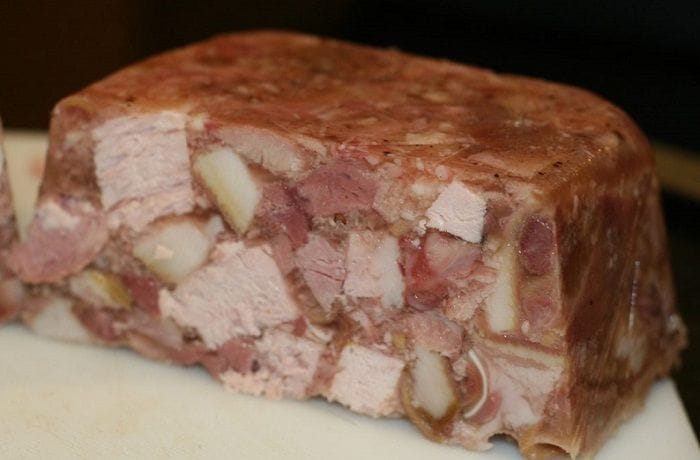
Chilean pork head cheese (queso de cabeza de chancho) is a pressed pork terrine made from a cooked pig’s head, feet, and ham shredded with garlic, chili sauce, white wine, and vinegar, then packed into a mold and refrigerated for 12 hours until the natural collagen sets it into a firm, sliceable block. Each serving provides approximately 300 calories.
It requires no added gelatin — the pig’s skin and trotters release enough collagen during cooking to bind the terrine completely. Served cold, sliced on marraqueta bread with pebre, it is one of the most traditional breakfast and appetizer preparations in Chilean rural cuisine.
How to Make Chilean Pork Head Cheese?
The critical step is pressing: after the seasoned, chopped meat is packed into the mold wrapped in cheesecloth, it must be weighted down firmly during the first hour of cooling to expel excess liquid and compact the pieces into a cohesive block. Without pressure, the terrine separates into loose chunks when sliced. Once the natural gelatin from the skin and trotter collagen has set during 12 hours of refrigeration, the head cheese holds its shape cleanly and can be sliced thin. The 12-hour setting time is not optional — attempting to unmold before it is fully set will result in the terrine collapsing.
Nutritional Information
Each serving of Chilean pork head cheese contains approximately 300 calories, 5 g of carbohydrates, 20 g of fats, 22 g of proteins, 0 g of fiber, 2 g of sugars, and 700 mg of sodium.
Chilean Pork Head Cheese Recipe
Active Prep Time: 30 minutes
Cook Time: 60 minutes
Setting Time: 12 hours (refrigerated)
Servings: 6
Ingredients
- 1 pig’s head, pre-cooked
- 2 pig’s feet, pre-cooked
- 1 pig’s ham (pernil), pre-cooked
- 4 cups of broth from cooking the head
- 250 g Chilean chili sauce (color chileno)
- 1 cup white wine
- 1 cup white wine vinegar
- 3 garlic cloves, finely minced
- 2 tablespoons dried oregano
- 2 bay leaves
- Cumin, salt, and pepper to taste

Instructions
- Place the pre-cooked pig’s head, feet, and ham in a large pot. Add the bay leaves and white wine and cover with water. Bring to a boil and cook for 10 minutes. Drain, reserving 4 cups of the cooking broth. Discard the bay leaves.
- While the meat is still warm, pick it carefully: remove the ears, skin, cheek meat, tongue, and any firm lean meat from the head and feet. Discard large pieces of pure fat and any bone fragments. Chop everything into small, irregular pieces roughly 1 to 2 cm — do not mince; the texture should remain visible after pressing.
- Transfer all the chopped meat and skin to a large bowl. Season with the chili sauce, white wine vinegar, minced garlic, oregano, cumin, salt, and pepper. Mix thoroughly until every piece is evenly coated. Taste and adjust — the mixture should be assertively seasoned, as the flavor mellows slightly during pressing and refrigeration.
- Return the seasoned meat to the pot with the 4 cups of reserved broth. Bring to a boil and cook for 10 minutes, stirring occasionally. The broth will reduce and intensify.
- Line a rectangular mold (loaf pan or similar) with a large piece of damp cheesecloth, leaving enough overhang to fold over the top. Ladle the meat mixture into the mold, pressing it down firmly to eliminate air pockets. Pour in just enough of the remaining broth to barely cover. Fold the cheesecloth over the top and place a second container or a weighted board directly on the surface.
- Allow to cool at room temperature for 1 hour with the weight in place, then transfer to the refrigerator — still weighted — for at least 12 hours.
- To unmold: briefly set the base of the mold in hot water for 15 to 20 seconds to loosen the gelatin at the edges. Unfold the cheesecloth from the top, invert onto a serving board, and peel off the cloth. Slice with a sharp knife dipped in hot water between cuts.
Additional Tips
Weight the mold during pressing — it is what makes the terrine hold its shape
The most common failure point in homemade head cheese is not applying enough pressure during the setting stage. The weight compresses the meat pieces together, forces out excess liquid, and allows the collagen-rich broth to penetrate every gap between pieces — when it sets, it acts as a binder that holds the slices together. A 1 to 2 kg weight placed directly on the cheesecloth-covered surface is sufficient for a standard loaf-pan mold. A second identical loaf pan filled with water works well. Without the weight, the finished terrine will be crumbly, wet, and prone to falling apart when sliced.
Include plenty of skin and trotter — they provide all the setting gelatin
The pig’s skin and the connective tissue from the trotters are the structural elements of the recipe. During the initial long boil of the head, they release collagen that dissolves into the cooking broth. That collagen-rich broth, poured back over the seasoned meat before pressing, sets to a firm gel in the refrigerator — binding the terrine without any added gelatin or thickener. If you trim away all the skin during the picking stage, the terrine will be soft and may not set firmly enough to slice cleanly. Aim to include roughly 30 to 40% skin and gelatinous parts alongside the lean meat in the final mixture.
Taste and season aggressively before pressing
The seasoned meat mixture should taste noticeably intense before it goes into the mold — more assertive than you would want in the finished dish. The pressing process dilutes the seasoning as liquid is expelled and the broth redistributes through the mass. Under-seasoned head cheese is one of the most common complaints and the hardest to fix after the fact, since you cannot adjust it once it is pressed and set. Pay particular attention to the vinegar balance: the acidity should be clearly present but not sharp. If the mixture tastes too acidic before pressing, add a teaspoon of sugar; if it tastes flat, add a tablespoon more of vinegar.
| Ingredient | Substitution and result |
|---|---|
| Pig’s head + feet | 1 kg boneless pork shoulder + 500 g pig’s trotters — easier to source; same collagen yield from the trotters; slightly less gelatinous skin |
| Chilean chili sauce (color chileno) | 2 tablespoons sweet paprika + 1 teaspoon chili flakes dissolved in 2 tablespoons vegetable oil — acceptable substitute for the color and mild heat |
| White wine vinegar | Apple cider vinegar — slightly softer, fruitier acidity; use same quantity |
| White wine | Chilean pilsner beer — less aromatic; adds a mild malt note that complements the pork; use same quantity |
Frequently Asked Questions (FAQs)
1. Why is it called “head cheese” if it contains no cheese?
The name refers to the technique, not the ingredients. “Cheese” in this context describes the pressing and molding process — the same method used to make farmhouse cheese from curd was applied to pressed meat terrines in medieval Europe. The cooked meat and skin are packed under pressure into a mold, just as cheese curd is pressed into a form to expel whey and consolidate the mass. In Spanish, queso de cabeza (head cheese) follows the same logic: “queso” refers to the pressed, molded character of the product, not to any dairy content. The dish is found across European cuisines under different names — fromage de tête in France, Sülze in Germany, brawn in England — all reflecting the same pressing tradition.
2. What makes the head cheese set firm without added gelatin?
The pig’s skin, ears, and trotters contain very high concentrations of collagen — the structural protein in connective tissue. During the long initial boil of the head and feet, this collagen breaks down into gelatin and dissolves into the cooking broth. When that collagen-rich broth is poured back over the seasoned meat in the mold and the whole preparation is refrigerated, the dissolved gelatin re-solidifies into a firm gel that binds all the meat and skin pieces together. The higher the proportion of skin and trotter to lean meat, the firmer the set. No commercial gelatin is needed if the cooking process is correct and enough skin is included.
3. How long does homemade head cheese keep?
Refrigerated and kept wrapped or in an airtight container, homemade queso de cabeza keeps for 5 to 7 days. It must be kept cold at all times — it does not keep at room temperature once unmolded. The vinegar in the seasoning acts as a mild preservative that slightly extends the shelf life compared to unseasoned terrines. Signs of spoilage include a sour or off smell, surface sliminess, or discoloration of the gelatin. Head cheese does not freeze well — the gelatin becomes watery and the texture deteriorates significantly when thawed.
4. How is Chilean head cheese served traditionally?
In Chile, queso de cabeza is most commonly served at breakfast or as an appetizer (entrada), sliced thin and placed directly on a marraqueta (Chilean white bread roll) or hallulla. It is almost always accompanied by pebre — the Chilean fresh salsa of tomato, onion, cilantro, and chili — whose acidity and freshness cut through the richness of the pork terrine. It is also served on cheese boards alongside other cured meats, pickled vegetables, and crusty bread. In rural southern Chile, it is a standard product of the matanza del chancho (pig slaughter day) and is made in large quantities to last several days after the event.
What Is Chilean Pork Head Cheese?
Queso de cabeza de chancho is a pressed pork terrine made from the secondary cuts of the pig — head, ears, cheeks, tongue, skin, and trotters — that would be too awkward or perishable to cook and serve in any other form. The cooked meat is shredded, seasoned with chili sauce, garlic, oregano, cumin, and white wine vinegar, then packed tightly into a mold with the collagen-rich cooking broth and pressed under weight while it refrigerates for 12 hours. The collagen from the skin and connective tissue sets the broth into a firm gel that binds the meat into a sliceable block with no added gelatin. The result is a product that is denser than a pâté, firmer than a rillette, and more textured than a mousse — visibly showing the different components (meat, skin, occasional cartilage) in cross-section. It is a product of the whole-animal tradition of Chilean rural pig farming, where every cut was used and nothing was discarded after a matanza (slaughter day).
History of Chilean Pork Head Cheese
Head cheese is a Medieval European peasant preparation developed as a practical solution to the problem of the pig’s head — the most perishable, most irregularly shaped, and most labor-intensive part of the animal to cook. Boiling the entire head, picking the meat, and pressing it in its own gelatin was the most efficient way to preserve and serve these secondary cuts. Versions of the preparation existed across Europe by the 14th and 15th centuries, each adapted to local seasoning traditions. The preparation arrived in Chile with Spanish colonial settlers in the 16th and 17th centuries and became integrated into the matanza del chancho — the annual or seasonal pig slaughter that was the central food preservation event in rural Chilean households before refrigeration. The Chilean version developed a more acidic, spiced character than its European equivalents, incorporating the local chili sauce (color chileno), white wine vinegar, cumin, and oregano — a seasoning profile that distinguishes it clearly from the milder European brawn or the herb-forward French fromage de tête. Queso de cabeza became particularly established in the central and southern regions of Chile (O’Higgins, Maule, Bio-Bío, La Araucanía), where pig farming was a standard part of smallholder agriculture and the matanza was a community event. Today it is produced commercially and sold in supermarkets, but the homemade version remains a valued product of regional Chilean food culture.
Did you know?
In Chile, queso de cabeza is produced and consumed mainly in the central and southern regions of the country, where the tradition of the matanza del chancho remains alive in rural communities. The matanza is not only a food production event — it is also a social occasion: neighbors and extended family gather to participate in the slaughter and processing of one or more pigs, and the day’s production includes multiple charcuterie products simultaneously (queso de cabeza, longaniza, chicharrón, arrollado de chancho) that are divided and shared among the participants. This communal pig-processing tradition is closely related to similar practices found in Spain, Germany, and France, all of which arrived in Chile through different waves of immigration during the colonial and republican periods.