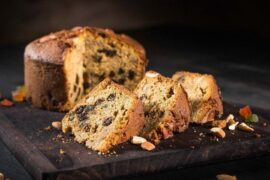
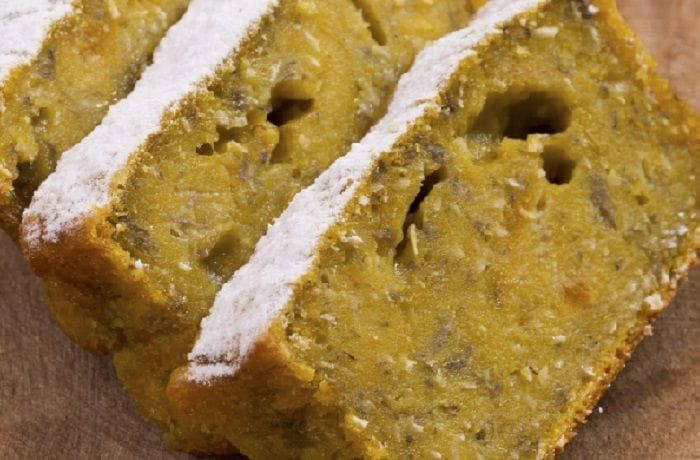
Rapa Nui banana po’e is a traditional Easter Island sweet banana and pumpkin cake — ripe bananas and grated pumpkin worked by hand with butter, flour, sugar, and shredded coconut, baked for 60 minutes until moist in the center. A cornerstone of Rapa Nui cuisine, each serving delivers around 400 calories and the distinctive tropical coconut and banana aroma that reflects the Polynesian roots of Easter Island cooking.
How to Make Banana Po’e?
Preparing banana po’e is a hand technique — the bananas and pumpkin are worked by hand with the butter until smooth, then the dry ingredients are incorporated without overmixing. The key textural indicator is moisture: a properly baked po’e remains moist in the center, never dry. A skewer inserted in the center should come out with a few moist crumbs — not clean (over-baked) and not wet with raw batter.
Nutritional Information
Each serving of Rapa Nui banana po’e contains approximately 400 calories, 75 g of carbohydrates, 8 g of fats, 5 g of protein, 3 g of fiber, 45 g of sugars, and 80 mg of sodium.
Rapa Nui Banana Po’e Recipe
Preparation: 20 minutes
Cooking: 60 minutes
Servings: 10 people
Ingredients
- 1½ kg of ripe bananas
- 500 g of flour
- 500 g of sugar
- 300 g of grated yellow pumpkin
- 300 g of soft butter or lard
- 70 g of shredded coconut
- 35 g of powdered milk
- 6 ml of coconut essence
Instructions
- Preheat the oven to 180°C (356°F) and butter a hollow or extended cake mold.
- In a large bowl, add the peeled bananas and grated pumpkin, mix with your hands while adding butter or lard. Knead until everything is integrated and a homogeneous mixture is obtained.
- Add the sifted flour, sugar, shredded coconut, powdered milk, and coconut essence, kneading with your hands until you obtain a mixture with a uniform texture.
- Distribute the mixture in the previously buttered mold, leveling the surface with your fingers.
- Place in the preheated oven and cook for 50 to 60 minutes or until the po’e is cooked and moist in the center, checking with a skewer or toothpick — it should come out with moist crumbs, not wet batter. Remove from the oven, cool, and unmold.
- Serve cold and sliced as desired, alone or accompanied by tea, coffee, or natural juice.
Additional Tips
Use very ripe bananas — the riper the banana, the sweeter and more aromatic the po’e
Bananas with deep yellow skins covered in brown spots are ideal — they have the highest sugar content and the most intense banana flavor. Completely black-skinned bananas that are too soft to eat are actually perfect for baking: the starches have fully converted to sugars, producing a naturally sweeter po’e without needing extra sugar. Green or barely ripe bananas will produce a starchy, less aromatic result with a noticeably inferior flavor.
Mix by hand, not with a mixer — overmixing develops gluten and toughens the cake
The hand-kneading technique is not traditional sentiment — it is the correct technique for this style of moist, dense cake. An electric mixer develops the gluten in the flour excessively, producing a tight, rubbery crumb rather than the characteristic dense-but-tender texture of po’e. Work by hand until the dry ingredients are just incorporated and no dry pockets remain — stop at that point, regardless of whether the mixture looks perfectly smooth.
The center should be moist, not dry — po’e is not meant to come out clean on the skewer
Unlike standard cakes where a clean skewer indicates doneness, properly baked po’e should show a few moist crumbs on the skewer when tested at 50 minutes. If the skewer comes out clean, the po’e has been overbaked and will be dry. The moist center is a deliberate characteristic of this preparation — it firms up further as the cake cools, reaching the correct texture after 30 to 60 minutes of resting at room temperature or after refrigeration.
| Ingredient | Substitution and result |
|---|---|
| Butter | Lard — traditional Rapa Nui version; slightly richer, less sweet flavor |
| Grated pumpkin | Sweet potato (camote) — denser texture, sweeter flavor; the Peruvian-style variation |
| Shredded coconut | Desiccated coconut (finely cut) — same flavor, finer texture in the finished cake |
| Coconut essence | Fresh grated coconut (50 g extra) — more aromatic, more complex coconut flavor |
Frequently Asked Questions (FAQs)
1. What is po’e in Rapa Nui culture?
Po’e — pronounced “poh-eh” — is a traditional Polynesian preparation in which fruit or root vegetables are mixed with starch, sweetened, and baked or steamed. The word appears across Polynesian cultures from Hawaii to New Zealand (where it is called poi) in similar preparations. In Rapa Nui, po’e is made with available tropical fruits — most commonly banana (platano) or papaya — combined with pumpkin, flour, coconut, and butter. It functions as both a dessert and a sweet bread, served at family gatherings and celebrations.
2. Can I make banana po’e without pumpkin?
Yes — increase the banana quantity by 300 g to compensate for the removed pumpkin. The result will be a more intensely banana-flavored po’e with a softer, more uniform texture. The pumpkin’s role is to add bulk, moisture, and a subtle vegetal counterpoint to the banana sweetness — without it, the po’e is richer and sweeter. Sweet potato is the closest substitute if you want to maintain the two-ingredient base that defines traditional po’e.
3. How should I serve and store banana po’e?
Serve cold or at room temperature, sliced into squares or rectangles. Banana po’e is traditionally served alongside savory dishes — particularly fish, ceviche, and grilled meats — where its sweetness contrasts with the umami and salt of the main course. It keeps well refrigerated for up to 5 days, covered with plastic wrap or in an airtight container. The flavor and texture actually improve after 24 hours as the flavors integrate — like banana bread, it is better the day after baking.
4. What does Easter Island food taste like?
Rapa Nui cuisine is a hybrid of Polynesian and Chilean continental cooking, shaped by the island’s remoteness, tropical climate, and the ingredients historically available: fish, tuna, lobster, sweet potato, banana, pumpkin, coconut, and taro. Flavors tend toward the sweet and mild, with coconut as a defining aromatic thread. The influence of Chilean mainland cooking became stronger after the 20th century with increased access to imported ingredients, but traditional Rapa Nui dishes like po’e, umu (earth oven cooking), and raw fish preparations retain their distinctly Polynesian character.
What Is Rapa Nui Banana Po’e?
Rapa Nui banana po’e — poe de plátanos pascuense in Spanish — is a traditional Easter Island sweet cake made from ripe bananas and grated pumpkin worked with butter, flour, sugar, shredded coconut, and coconut essence, then baked until moist in the center. Unlike standard cakes, po’e has a dense, moist, almost pudding-like texture and is served cold, sliced, as a dessert or alongside savory fish and meat dishes. It is one of the most representative preparations of Rapa Nui cuisine and reflects the island’s Polynesian culinary heritage, where fruit-based baked and steamed preparations are central to the food culture.
History of Po’e in Rapa Nui
Rapa Nui (Easter Island) is a remote volcanic island located in Polynesia, 3.500 km from the Chilean coast and 4.000 km from Tahiti — one of the most isolated inhabited islands on Earth, famous for its over 900 monumental stone statues called moais, created by the island’s Rapa Nui people between the 13th and 16th centuries. The island became a Chilean territory in 1888 and has since been influenced by both Polynesian and continental Chilean food traditions.
Po’e is an ancient Polynesian preparation that predates European contact with the Pacific Islands. The word and the concept appear throughout Polynesian culture — in Hawaii as poi (fermented taro paste), in New Zealand as a baked pudding made with fruit and arrowroot. The banana version made on Rapa Nui reflects the tropical fruits available on the island and the adaptation of the Polynesian starch-and-fruit baking technique to local ingredients. Chilean colonial influence introduced wheat flour, butter, and powdered milk into the recipe, gradually shaping the banana po’e into its current form — a fusion preparation that embodies the meeting of Polynesian and South American culinary traditions.
Did You Know?
Bananas, a key ingredient in po’e, are an excellent source of energy due to their carbohydrate composition — green bananas provide more resistant starch, while fully ripe yellow bananas convert this starch into easily absorbed sugars (sucrose, fructose, and glucose). Bananas also contain significant amounts of potassium, magnesium, and manganese, making them one of the most nutritionally complete fruits used in traditional Polynesian cooking.