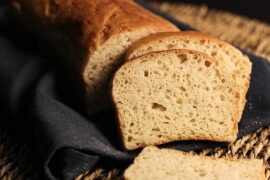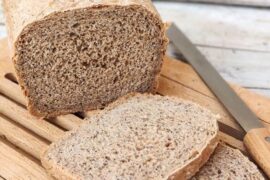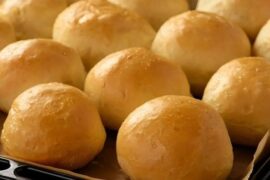
Chilean bread with pork cracklings (pan con chicharrones) is a leavened wheat bread made from 1 kg of flour, 150 g of lard, and 300 g of pork cracklings folded into the dough before shaping — the rolls rise for 60 minutes and bake for 30 minutes at 180°C until golden. Each serving provides approximately 450 calories.
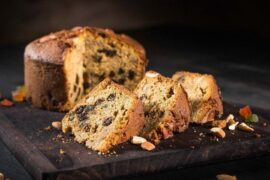
The defining characteristic is the textural contrast between the soft, lard-enriched crumb and the crisp, fatty pockets where whole chicharrón pieces are embedded — a combination of bread and crackling in every bite, not a crackling-flavored dough.
How to Make Bread with Pork Cracklings?
The technique follows standard enriched bread method with one key difference: the cracklings are worked into an already-formed dough rather than added with the dry ingredients. This preserves the crackling texture through the bake — if whole chicharrones are added too early and overworked, they break down into the dough and lose their characteristic crispy pockets. The lard is incorporated warm alongside the water, which keeps the fat pliable and allows it to coat the gluten strands evenly. If you are making the chicharrones at home, you can use the warm fat rendered during cooking directly in the dough — the fat will already be saturated with pork drippings and deepens the bread’s flavor beyond what plain store-bought lard achieves.
Nutritional Information
Each serving of bread with pork cracklings contains approximately 450 calories, 70 g of carbohydrates, 15 g of fats, 10 g of proteins, 3 g of fiber, 1 g of sugars, and 300 mg of sodium.
Bread with Pork Cracklings Recipe
Prep Time: 60 minutes (including 60 minutes rise time)
Cook Time: 30 minutes
Servings: 6
Ingredients
- 1 kg all-purpose flour, plus extra for dusting
- 750 ml warm water
- 300 g pork cracklings (chicharrones)
- 150 g lard, warmed to room temperature
- 40 g fresh yeast (or 14 g instant dry yeast)
- 2 teaspoons salt
- 1 teaspoon sugar
Instructions
- In a large bowl, add the flour and make a well in the center. Add the salt, crumbled fresh yeast, and sugar into the well. Pour in the warm water and warmed lard — if you prepared the cracklings at home, use the warm rendered fat from the cooking process in place of plain lard. Mix everything together until a rough dough forms with no dry flour pockets.
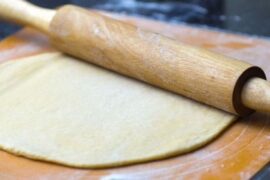
- Turn the dough out onto a lightly floured surface and knead for 8 to 10 minutes until it is smooth, elastic, and no longer sticks to your hands. The dough should spring back slowly when pressed with a finger.
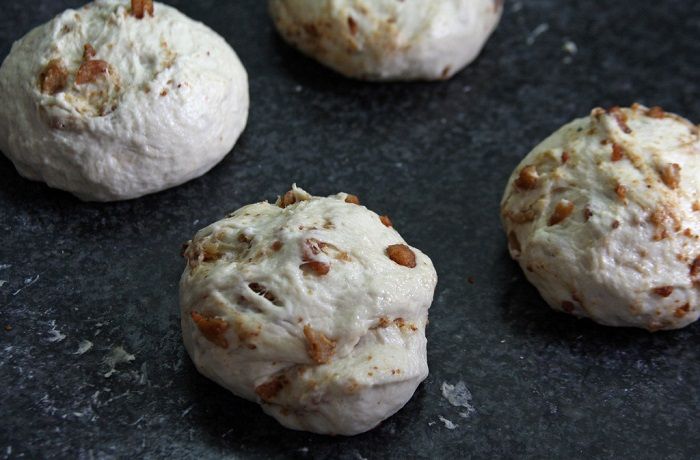
- Flatten the dough into a rough rectangle on the floured surface. Distribute the pork cracklings evenly across the surface, then fold the dough over them and knead gently for 2 to 3 minutes — enough to distribute the cracklings evenly without breaking them down completely. You should see visible pieces of crackling throughout the dough.
- Divide the dough into 6 equal portions. Shape each one into a rounded, slightly flattened roll. Place on a baking tray lined with parchment paper, leaving space between rolls for expansion. Cover with a clean kitchen towel and allow to rise in a warm place for 60 minutes, or until doubled in size. Preheat the oven to 180°C (356°F) during the last 10 minutes of the rise.
- Prick the surface of each roll several times with a fork — this prevents large air bubbles from forming under the crust during baking. Place in the preheated oven and bake for 30 minutes until the rolls are golden brown on top and sound hollow when tapped on the base.
- Serve warm on their own, with homemade butter, pebre (Chilean salsa), or merkén sauce. These rolls are best eaten the same day, while the cracklings are still crisp inside the crumb.
Additional Tips
Use warm lard — cold fat won’t integrate into the dough properly
Lard must be at a workable temperature — neither melted (liquid fat creates a greasy dough that is difficult to knead) nor cold and solid (which leaves unmixed fat chunks that never fully incorporate). The right consistency is soft and pliable, similar to room-temperature butter. If the lard is cold from the refrigerator, warm it briefly over very low heat until it softens but does not melt, then allow it to cool for 5 minutes before adding to the dough. If using the fat rendered from making chicharrones at home, allow it to cool until it thickens from liquid to a thick, pourable consistency before incorporating — usually 15 to 20 minutes at room temperature. This warm fat, carrying the pork drippings from the frying process, produces a noticeably more flavorful bread than plain lard alone.
Add the cracklings after the dough is formed — not at the start
The recipe calls for working the cracklings into a fully formed dough in step 3, not mixing them with the flour from the beginning. The reason is structural: if whole chicharrones are added with the dry ingredients and subjected to the full 8 to 10 minutes of initial kneading, they are progressively ground down into the dough and lose both their texture and their visual identity in the final roll. Adding them late preserves intact pieces — soft interior, slightly crispy exterior — that create the characteristic pockets of crackling throughout the crumb. Handle the dough gently after adding the cracklings: 2 to 3 minutes of light kneading is sufficient to distribute them; overworking at this stage achieves nothing except breaking down the crackling further.
Cold kitchen? Rise the dough near the warm oven — 60 minutes is the minimum
This dough uses 40 g of fresh yeast for 1 kg of flour, which is a relatively high yeast ratio that ensures an active rise even in cool conditions. However, the 60-minute rise time is calibrated for a kitchen at approximately 20 to 22°C. In a cold kitchen (below 18°C), the dough may take 80 to 90 minutes to double. To compensate: turn the oven on to 50°C for 5 minutes, then turn it off and place the covered dough inside with the door slightly ajar — the residual heat creates a stable warm environment for the yeast. The rolls are ready to bake when they have clearly doubled in size and the dough springs back very slowly (more than 5 seconds) when pressed lightly. If the dough springs back immediately, it needs more time. If it does not spring back at all, it is over-proofed and will not rise further in the oven.
| Ingredient | Substitution and result |
|---|---|
| Fresh yeast (40 g) | Instant dry yeast (14 g / 2 standard sachets) — dissolve directly in the warm water before adding to the flour; no “blooming” needed; rise time may be 10–15 minutes shorter |
| Lard (150 g) | Vegetable shortening — nearly identical dough texture; butter (unsalted, softened) also works but adds a slight dairy flavor and produces a slightly more tender, less flaky crumb |
| Pork cracklings (300 g) | Cooked bacon, crumbled — similar fat content and pork flavor; pieces integrate more finely into the dough, producing a more uniform crackling distribution rather than distinct pockets |
| Water (750 ml) | Whole milk — richer, slightly sweeter dough with a more golden crust; reduce lard to 100 g if using whole milk to avoid an overly rich, dense result |
Frequently Asked Questions (FAQs)
1. What is “pan chilote” and is it the same as this recipe?
“Pan chilote” is the bread from the Chiloé archipelago in southern Chile, and it is closely related but not identical to this recipe. The Chiloé version traditionally incorporates potato starch or cooked mashed potato alongside the wheat flour, producing a denser, moister bread with a different crumb texture — a reflection of Chiloé’s unique food culture where native potatoes are central to most preparations. The mainland pan con chicharrones, shown on this page, uses only wheat flour and relies on lard for moisture and texture, yielding a lighter, more open crumb. Both share the chicharrones-in-dough technique and are often referred to interchangeably in everyday Chilean speech, but they are technically distinct preparations.
2. Can I make the pork cracklings at home for this recipe?
Yes, and the recipe explicitly recommends it — the warm rendered lard from homemade chicharrones can be used directly in the dough. To make chicharrones at home: cut pork skin with some adherent fat into 3 to 4 cm pieces, place in a pot with a small amount of water, and cook over medium-high heat until all the water evaporates and the pieces begin to fry in their own rendered fat. Continue until the pieces are golden and crispy — 20 to 30 minutes total. Drain the chicharrones on paper, reserve the fat, allow both to cool to the correct temperatures (warm but not liquid), and use as specified in the recipe. Store-bought chicharrones work equally well but tend to be drier and saltier — reduce the added salt slightly if using commercially produced cracklings.
3. Why are the rolls pricked with a fork before baking?
Pricking the surface with a fork — a step called “docking” in baking — releases steam from the interior of the dough during baking, preventing large air pockets from forming between the crumb and crust. In an enriched dough like this one (with high lard content), steam tends to accumulate beneath the surface during the early stages of baking as the fat renders and expands. Without docking, this steam has nowhere to go and creates uneven large bubbles that separate the crust from the crumb, resulting in hollow shells rather than solid rolls. The fork holes are small enough that they close during baking and are not visible in the finished bread — they serve a structural function only.
4. How long does bread with pork cracklings keep?
These rolls are best eaten the same day they are baked, while the cracklings embedded in the crumb are still crisp. After 24 hours at room temperature, the bread softens normally but the cracklings inside lose their texture and become chewy rather than crispy. For storage beyond the same day, wrap individually and refrigerate for up to 2 days — reheat in a 160°C oven for 8 to 10 minutes to partially restore the crust. Freezing is possible (freeze fully cooled rolls individually wrapped) for up to 1 month; reheat directly from frozen at 180°C for 15 minutes. The crackling texture does not fully survive freezing, but the bread itself reheats well.
What Is Chilean Pan con Chicharrones?
Chilean bread with pork cracklings (pan con chicharrones) is a leavened wheat bread enriched with lard and folded with whole fried pork skin pieces before shaping into rolls. It is also called “pan chilote” in common usage, though strictly speaking pan chilote is a Chiloé variant that uses potato in the dough. The recipe on this page is the mainland Chilean version: pure wheat flour enriched with 150 g of lard and 300 g of whole chicharrones per kilogram of flour, yielding a soft, fatty crumb with crispy pork pockets throughout.
Pork cracklings (chicharrones) in Chile are the fried skin of the pig with some adherent fat, rendered until crispy but not puffed — distinct from the commercially made dry-fried rinds sold in bags. The version used in this bread is the fresh chicharrón produced during home pig rendering: the skin and fat are cooked in their own lard until golden, producing a product that is soft-crispy rather than hard-brittle, and that absorbs flavors from the dough during baking rather than simply remaining unchanged inside it.
Chicharrón is rich in protein, which is essential for muscle repair and growth. It contains fats — both saturated and unsaturated — which provide energy and support cell function. As with all high-fat preparations, the bread is calorie-dense and best understood as an occasional traditional preparation rather than a daily staple. In Chile it has historically served as a high-energy food for agricultural workers and remains a traditional cold-weather preparation, typically made in autumn or winter when pig-rendering season coincides with the cooler months.
History of Pan con Chicharrones in Chile
Bread enriched with rendered animal fat is one of the oldest techniques in European baking — lard bread has documented roots in Spanish, Italian, and Eastern European cooking traditions, all of which arrived in the Americas through colonial migration. In Chile, the preparation merged with the annual practice of “matanza del chancho” (pig slaughter), typically conducted in late autumn in rural households, when a single pig was rendered into lard, chicharrones, longaniza, and other preserved products. The warm fat and fresh cracklings produced during this process went directly into bread dough the same day — a practical technique that used the byproducts of rendering before they cooled, and that produced a bread richly flavored by the just-rendered pork fat.
The Chiloé archipelago, in southern Chile, developed its own variant (pan chilote) that incorporated native potatoes into the dough — a logical adaptation in a region where potato biodiversity is unmatched anywhere outside the Andes and where wheat flour was historically a more expensive import. The potato added moisture and a distinctive dense crumb to the Chiloé version, while the mainland Chilean pan con chicharrones maintained the pure wheat-and-lard formula that Spanish colonial baking tradition prescribed. Both versions appear in Chilean cookbooks from the 19th century onward and remain common in rural areas and in traditional restaurants (fondas and picadas) that specialize in heritage Chilean cuisine.
Did you know?
The word “chicharrón” derives from the onomatopoeia of hot fat frying — the “chich” sound that pork skin makes when it hits hot oil — which is also the root of the Spanish verb “achicharrar” (to char by overheating). The Real Academia Española traces the word to this sound-based origin, making it one of the few culinary terms in Spanish whose etymology is directly phonetic. In Chile, chicharrones are classified into two main types: chicharrón de cerdo (fried pork skin with fat, used in this recipe) and chicharrón de ave (typically fried chicken skin). The term “pan de chicharrones” appears in Chilean household cookbooks from the mid-19th century, where it is consistently listed as a preparation suited to the pig-rendering season — specifically because the fresh, warm fat and cracklings from the same day’s rendering were the optimal raw material. In Chiloé, the preparation took on a cultural significance beyond its practical origins: pan chilote became associated with the “minga” — the traditional Chiloé community practice of collective labor where neighbors gathered to help move houses (literally, houses in Chiloé were transported by boat), and where chicharrón bread was a standard provision for the workers. Today, pan con chicharrones remains one of the most searched traditional Chilean bread recipes online, reflecting a broader revival of interest in heritage preparations that use whole-animal cooking techniques.