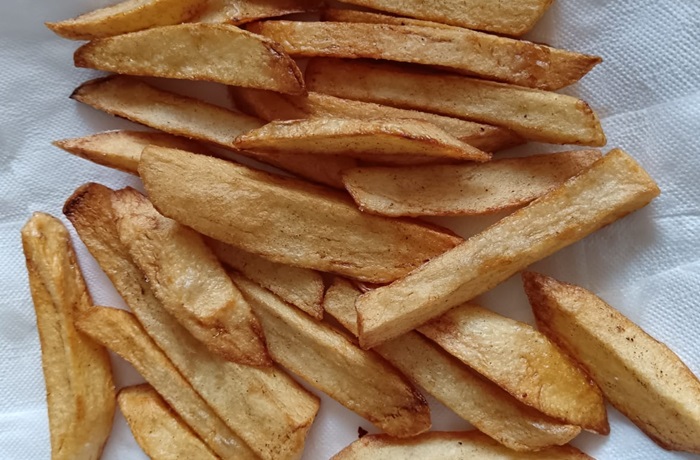
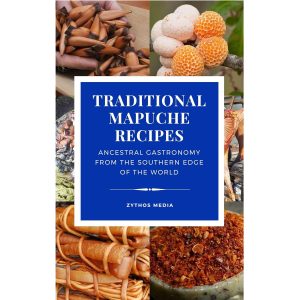
The secret to perfect Chilean fries lies in a two-stage fry: a first pass at 140°C in pork lard to cook the potato through, and a second at 180°C to form a golden, shatteringly crispy crust. Fried potatoes are probably the most international of all culinary preparations—a perfect combination of a product and a South American technique that, contrary to popular belief, did not originate in Belgium or France, where it was later refined, but in southern Chile, as part of Mapuche gastronomy.
Nutrition Facts
Each serving of fried potatoes contains approximately 355 kcal, 4 g of protein, 20 g of fat (3 g of saturated fat), 0 mg of cholesterol, 42 g of carbohydrates, 0 g of sugars, and 240 mg of sodium. (*)
(*) Estimated values may vary depending on ingredients and portion sizes.
How to Make Chilean Fries in Pork Lard
It is recommended to use potato varieties with low water content and high starch levels, firm and resistant in structure; in Chile, the Yagana, Puyehue, and Ona varieties are particularly recommended, fried in natural pork lard.
Prep Time: 50 minutes
Cook Time: 15 minutes
Servings: 6
Ingredients
- 2 kg firm potatoes
- 500 g pork lard
- Sea salt
- Merkén

Instructions
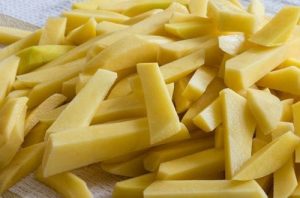
- Wash, peel, and cut the potatoes into 1 cm thick sticks. Soak in cold water for 5 minutes, rinse until any excess starch is removed, and dry with a kitchen towel or paper towels. Set aside. In a deep fryer or deep pan, add enough lard and heat over high heat until it reaches 140°C (284°F).
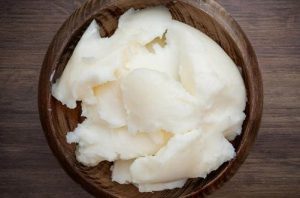
- Carefully add the potatoes little by little, without overcrowding; make sure they are fully covered with lard and fry for about 5 to 6 minutes until lightly golden. Remove with a slotted spoon, drain on paper towels, and cool completely, ideally in the freezer for 20 minutes.
- Heat the lard over high heat until it reaches 180°C (356°F). Add the potatoes again and fry for 1 to 2 minutes until golden and crispy. Remove and drain in a bowl lined with paper towels, season with salt to taste in a light shower, optionally add a pinch of merkén, and gently toss the bowl to mix. Serve immediately, hot, either on their own or accompanied by mayonnaise, ketchup, and/or chili sauce.
Additional expert tips
Single-step frying method
If you are looking for a simpler and more direct preparation, you can fry the potatoes in a single step at 175–180°C (347–356°F) in small batches for 6 to 8 minutes, gently stirring halfway through to prevent sticking.
Pork lard alternatives
If you do not have pork lard, choose oils with a high smoke point to avoid the formation of acroleins; a common option is high-oleic sunflower oil, which can withstand multiple heating cycles without oxidizing.
Why no batter is needed
Potatoes do not need to be battered, as they contain a high amount of starch; it is only necessary to carefully control cooking temperatures to form the crust while preserving internal steam—a technique that may seem simple but took centuries to perfect.
Frying fats at a glance
| Fat or oil | Smoke point | Flavor | Crispiness | Reuse cycles |
|---|---|---|---|---|
| Pork lard | ~190°C (374°F) | Rich, traditional | Excellent | 3–4 |
| Beef tallow | ~205°C (401°F) | Meaty, savory | Excellent | 3–4 |
| High-oleic sunflower oil | ~230°C (446°F) | Neutral | Very good | 4–5 |
| Regular sunflower oil | ~160–170°C (320–338°F) | Neutral | Good | 1–2 |
| Extra virgin olive oil | ~190°C (374°F) | Fruity, mild | Good | 1–2 |
Frequently Asked Questions (FAQ)
1. Why is pork lard the best option?
Pork lard is not an ultra-processed fat; it is a traditional product, minimally processed and stable at high temperatures. Approximately 45–50% of its fatty acids are monounsaturated, the same type predominant in olive oil. In addition, its thermal stability means it oxidizes less during frying, generating fewer undesirable compounds.
2. Is it always necessary to peel the potatoes?
Not necessarily. “Rustic potatoes” (with skin on) retain more of their earthy flavor and provide additional fiber that aids digestion. If you leave the skin on, it is essential to wash them thoroughly to remove any traces of solanine or soil.
3. When is the exact moment to add salt?
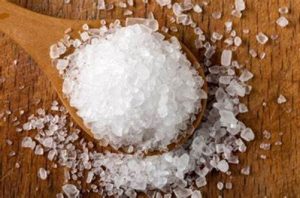
Immediately after the second fry. The residual heat allows the salt crystals to adhere to the thin surface layer of oil before it cools and becomes viscous. If you salt too late, the salt will simply fall to the bottom of the bowl.
4. Why does cooling the potatoes between fries improve the result?
Cooling allows the gelatinized starch to restructure and the internal steam to stabilize. When the potatoes are returned to hot fat, the thermal contrast causes rapid surface dehydration, forming a firmer, crispier crust without overcooking the interior.
History and Origin of Fried Potatoes
French fries are often presented as a European preparation that emerged in the late 17th century in Belgium or France; however, the first documented record is found in the manuscript of the book “Cautiverio Feliz” (1677), in which Francisco Núñez de Pineda y Bascuñán describes, in the context of his captivity among the Mapuche, the consumption of potatoes cut and cooked in hot fat around the year 1629.
Did You Know?
Genetic research published in 2025 has shown that the modern potato (Solanum tuberosum) originated in south-central Chile as a result of a natural hybridization event between an ancestor of the tomato and a wild species from the lineage of non-tuber-bearing potatoes. This genetic cross enabled the emergence of the tuber, the defining trait of the potato as we know it today, and explains its extraordinary capacity for agricultural adaptation.