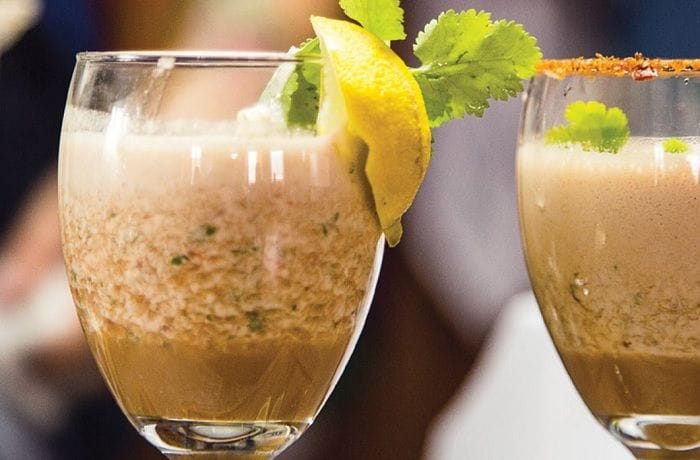
The Chaihuín seafood smoothie (batido criaturero) is a blended shellfish drink from Caleta Chaihuín on the Valdivian coast — 6 Choro Zapato mussels and 2 piures blended with 500 ml of white wine, garlic, cilantro, and merkén, then served cold in flute glasses. Ready in 15 minutes. Each serving provides approximately 200 calories.
Originally published in the cookbook “On the Route of the Choro Zapato from Caleta Chaihuín,” this recipe is tied to a single estuary where the unique mix of fresh river water and Pacific seawater produces a mussel with an uncommonly sweet flavor found nowhere else on the Chilean coast.
How to Make a Chaihuín Seafood Smoothie?
The Choro Zapato mussel from Chaihuín has been gaining prestige among Chilean chefs and food writers for its distinctive sweetness — a direct result of the brackish conditions of the Chaihuín river estuary. The key to this recipe is using freshly opened raw shellfish: blending pre-cooked or canned shellfish produces a flat, metallic result that loses the brininess and sweetness that make this drink distinctive. The blend should remain slightly coarse rather than perfectly smooth — 10 to 15 seconds at medium speed — so the texture retains evidence of the shellfish rather than becoming a uniform liquid.
Nutritional Information
Each serving of Chaihuín seafood smoothie contains approximately 200 calories, 8 g of carbohydrates, 4 g of fats, 8 g of proteins, 1 g of fiber, 3 g of sugars, and 450 mg of sodium.
Chaihuín Seafood Smoothie Recipe
Prep Time: 10 minutes
Blend Time: 5 minutes
Servings: 4
Ingredients
- 6 Choro Zapato mussels (or large fresh mussels), raw and freshly opened
- 2 piures, cleaned and flesh only
- 500 ml Chilean white wine, chilled
- 2 garlic cloves
- ½ onion
- A splash of seafood broth
- A few sprigs of fresh cilantro
- A few drops of sunflower oil
- Sea salt to taste
- Merkén (Chilean smoked chili spice) to taste
- Ice (optional)

Instructions
- Prepare all ingredients before blending (mise en place): open the mussels and remove the flesh, clean the piures and extract the red flesh, peel the garlic cloves, and roughly chop the half onion. Chill the glasses in the freezer for 5 minutes if possible.
- Add the mussel flesh, piure flesh, garlic cloves, onion, cilantro sprigs, a few drops of sunflower oil, and a splash of seafood broth to the blender. Blend at medium speed for 10 to 15 seconds until the mixture is blended but still slightly textured — do not over-blend to a perfectly smooth liquid.
- Add the chilled white wine, a pinch of sea salt, and merkén to taste. Add ice if desired. Blend briefly at low speed for 5 seconds just to combine — the wine should not be over-mixed or it will foam excessively.
- Taste and adjust seasoning. The smoothie should be briny, mildly spicy, and have a clear shellfish flavor balanced by the wine acidity. Serve immediately in chilled flute glasses, optionally with merkén pressed onto the moistened rim and garnished with a lemon slice and a fresh cilantro sprig.
Why Is It Called “Criaturero”?
In Chilean coastal culture, “criaturero” is a folk term applied to seafood preparations — typically broths, drinks, or raw shellfish combinations — believed to restore vitality and have aphrodisiac properties. The word derives from “criatura” (creature or child) and implies that the preparation is potent enough to encourage reproduction — a belief rooted in the high zinc, iodine, and protein content of raw Chilean shellfish, nutrients that have a documented role in hormonal function and reproductive health. The term is part of a broader Chilean coastal drinking culture centered on “fuerte” (strong) raw seafood preparations: raw sea urchin (erizo), raw piure, and shellfish-wine blends consumed at the port before meals. The piure specifically carries a strong cultural association with this type of preparation — its intense iodine flavor and distinctive red color make it the signature ingredient of criaturero-type drinks along the Chilean Pacific coast.
Additional Tips
Use raw, freshly opened shellfish — not pre-cooked or canned
This recipe depends entirely on the raw shellfish flavor. Heat destroys the volatile aromatic compounds responsible for the sweet, briny, oceanic quality of Choro Zapato and the intense iodine note of piure. Pre-cooked or canned mussels produce a flat, preserved-fish flavor that bears little resemblance to the live shellfish version. Open the mussels immediately before blending — raw bivalve flesh deteriorates quickly at room temperature. If you cannot source live mussels, fresh-frozen raw mussel meat is an acceptable second option, thawed in the refrigerator and used immediately after thawing. Never use piure from a can for this recipe; only fresh piure produces the correct flavor intensity.
Chill the wine and glasses before serving
The smoothie is consumed immediately after blending and should be cold from the first sip. Use wine that has been refrigerated for at least 2 hours before use. If the blender container is warm from previous use, rinse it with cold water before adding the ingredients. Flute glasses placed in the freezer for 5 minutes before serving maintain the cold temperature better than room-temperature glass. The optional ice serves as insurance against a warm result but slightly dilutes the shellfish intensity as it melts — use it only if the wine is not sufficiently chilled or if the ambient temperature is high.
Keep the blend short and coarse — this is not a puree
The texture should be slightly thick and visibly blended rather than silky-smooth. Over-blending (more than 20 seconds at medium speed) breaks the shellfish flesh completely, produces an unnaturally uniform liquid, and incorporates excess air that causes the drink to foam when the wine is added. Aim for a consistency similar to a rough vegetable juice — the shellfish pieces are broken down but the drink is not fully liquefied. Blending the wine in separately at the end (step 3) at low speed for just 5 seconds avoids over-mixing the wine and causing the alcohol to foam.
| Ingredient | Substitution and result |
|---|---|
| Choro Zapato mussels | Standard blue mussels (choritos/mejillones) or green-lipped mussels — smaller, slightly less sweet; increase to 10–12 pieces to compensate for size |
| Piures | Fresh sea urchin roe (erizo) — closest substitute for the intense iodine-oceanic note; use 2 tablespoons; or omit and increase mussels by 2 if unavailable |
| Chilean white wine | Any dry Sauvignon Blanc or Chardonnay — Chilean coastal Sauvignon Blanc is the most authentic match; avoid sweet or sparkling wine |
| Merkén | Smoked paprika + ½ teaspoon chili flakes — approximate substitute; lacks the Mapuche spice profile and toasted coriander note of authentic merkén |
Frequently Asked Questions (FAQs)
1. What is piure and can I substitute it?
Piure (Pyura chilensis) is a sea creature unique to the Chilean and Peruvian Pacific coast — a tunicate (sea squirt) that attaches to rocks in the intertidal zone and is harvested by artisanal divers. Its interior flesh is a deep red color with an intensely saline, iodine-forward flavor unlike any other shellfish. It is one of the most distinctly Chilean seafood ingredients and has no direct international equivalent. The closest substitute in flavor intensity is sea urchin roe (erizo), which shares the raw oceanic character, though without the same bitterness. Piure can occasionally be found frozen in Chilean specialty markets outside Chile; within Chile, it is sold fresh in coastal fish markets and some supermarkets in the south.
2. What does “criaturero” mean in Chilean culture?
“Criaturero” is a Chilean coastal folk term for seafood preparations — usually broths, raw shellfish drinks, or blended shellfish drinks — believed to restore vitality and have aphrodisiac properties. The word comes from “criatura” (creature or child). The belief is rooted in the high zinc and iodine content of Chilean raw shellfish, which are known to support hormonal function. The term is informal and colloquial — it appears in coastal restaurants as a descriptor for strong, raw seafood preparations, never on formal menus. The Chaihuín batido criaturero is one of the most well-documented examples of this preparation type, largely because of its inclusion in the local cookbook that documented the Caleta Chaihuín fishing community’s culinary traditions.
3. Is this seafood smoothie served hot or cold?
Cold — always. The wine is added chilled and the drink is consumed immediately after blending, optionally with ice. It is not a cooked preparation and does not involve any heat at any stage. Serving it warm would destroy the raw shellfish flavor and make the wine component taste flat and alcohol-forward. The chilled flute glass and the optional merkén-dusted rim are part of the presentation: this is served as an aperitivo — a drink consumed standing before a meal at the coast, not as a warm restorative like a broth.
4. What is Choro Zapato and how is it different from regular mussels?
Choro Zapato (Choromytilus chorus) is one of the largest mussel species in the world — it can reach 20 cm in length, which is significantly larger than the standard blue mussel (Mytilus chilensis, typically 6 to 10 cm). The name means “shoe mussel” in Spanish, a reference to its size and shape. It grows naturally along the Chilean and Peruvian Pacific coast, with the highest-quality specimens found in clean, cold estuarine waters. The Choro Zapato from Caleta Chaihuín is particularly prized because the Chaihuín river estuary creates a unique brackish environment — the freshwater dilutes the salinity and enriches the phytoplankton, producing a mollusk with a distinctly sweet, less briny flavor compared to open-ocean mussels.
What Is the Chaihuín Seafood Smoothie?
The Chaihuín batido criaturero is a blended shellfish aperitif native to Caleta Chaihuín, a small artisanal fishing community on the Valdivian coast of southern Chile (Región de Los Ríos). It combines two ingredients that are highly specific to Chilean Pacific shellfish culture — the Choro Zapato mussel and the piure — with white wine, garlic, cilantro, and merkén. The result is a cold drink served in flute glasses that sits at the intersection of cocktail and seafood appetizer: too savory and protein-rich to be a standard drink, too liquid and wine-based to be a conventional starter. It belongs to a broader category of Chilean coastal “fuerte” preparations — raw shellfish combinations consumed at the port, often standing, before a full meal — that are associated with the fishing community lifestyle of the southern Chilean coast. The merkén on the rim connects the preparation to Mapuche culinary tradition, anchoring it firmly in the food culture of the Valdivia-Los Ríos region.
History of the Chaihuín Seafood Smoothie
The recipe was first formally documented in the cookbook “On the Route of the Choro Zapato from Caleta Chaihuín,” a local publication produced to preserve and promote the culinary traditions of the Chaihuín fishing community. Caleta Chaihuín sits within the Valdivian Coastal Reserve (Reserva Costera Valdiviana), a protected area managed by The Nature Conservancy that covers approximately 60,000 hectares of temperate rainforest and coastline in the Región de Los Ríos. The Chaihuín river estuary — one of the most ecologically intact estuaries on the Chilean coast — has supported artisanal shellfish harvesting for generations, with Choro Zapato as the defining product of the local economy and identity. The criaturero tradition itself predates the cookbook: raw shellfish drinks blended with wine or pisco have existed in Chilean coastal communities as informal aperitivos for at least a century, embedded in the social culture of fishermen’s taverns and port-side restaurants. The Chaihuín version became documented and named because of the exceptional quality of the local mollusk and the community’s conscious effort to preserve its culinary heritage through the cookbook initiative.
Did you know?
Chaihuín is a small coastal town located within the Valdivian Coastal Reserve, where artisanal fishing is the main economic activity. The Chaihuín river forms a beautiful estuary at this locality — one of the most biodiverse coastal ecosystems in South America, where the temperate rainforest meets the Pacific Ocean. The Choro Zapato mussel that gives this recipe its primary flavor character grows specifically in this estuary, thriving in the unique brackish conditions where the river meets the sea. The Valdivian Coastal Reserve encompasses some of the last intact temperate rainforest in the Southern Hemisphere — a biodiversity hotspot that shares its ecological profile with the temperate rainforests of New Zealand and Tasmania — and the Chaihuín community lives within and depends on the health of this ecosystem for the quality of its shellfish harvests.