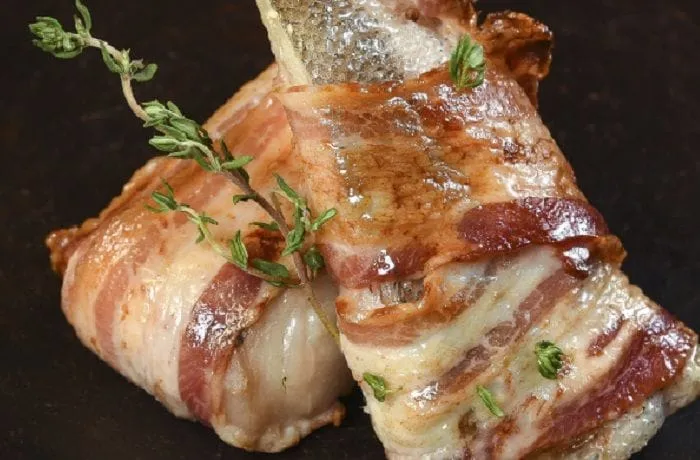
Chilean merluza asada con tocino is a straightforward oven dish in which southern hake fillets are seasoned with a garlic and thyme paste, laid over bay leaves, wrapped in two slices of smoked bacon each, and roasted at 200°C for 15 minutes. The bacon seals the fish, keeping it moist while crisping on the outside. A drizzle of lemon juice and fresh parsley added at the end cuts through the fat cleanly.
The dish is built around merluza austral — southern hake (Merluccius australis) — caught in the cold waters of Chilean Patagonia and the Humboldt Current. Its mild, firm flesh holds up well to oven cooking and absorbs herb flavors without losing its character. It is one of the most consumed fish in Chilean home cooking.
How to Make Chilean Roasted Hake Wrapped in Bacon?
Dry the fillets thoroughly before seasoning. Moisture on the surface of the fish prevents the garlic and thyme paste from adhering and causes the bacon to steam rather than crisp. If the fillets came from the freezer, pat them dry multiple times until no moisture transfers to the paper towel.
Place each fillet directly over a bay leaf — the leaf releases its aromatic oils upward into the fish throughout the roasting time. The bay leaf is not eaten, but its contribution to the final aroma is significant and should not be skipped.
Nutritional Information
Per serving (one fillet with two bacon slices): approximately 280 kcal, 30 g protein, 16 g total fat (6 g saturated), 2 g carbohydrates, 0 g sugars, 420 mg sodium. Hake is a low-calorie, high-protein lean fish and a good source of phosphorus, selenium, and vitamin B12. The bacon adds flavor and fat but not carbohydrates.
Chilean Roasted Hake Wrapped in Bacon Recipe
Prep time: 30 minutes | Cook time: 15 minutes | Servings: 6
Ingredients
- 6 hake fillets (merluza austral)
- 12 bacon slices (smoked, thin-cut)
- 6 bay leaves
- 3 tablespoons butter, melted
- 3 tablespoons fresh parsley, finely chopped
- 2 tablespoons neutral oil (for the baking dish)
- 2 tablespoons fresh lemon juice
- 1 teaspoon dried thyme
- 1 garlic clove
- Sea salt and black pepper to taste
Instructions
- Preheat the oven to 200°C (392°F). Pat the hake fillets dry with paper towels and season both sides with salt and black pepper. Crush the garlic clove with the flat of a knife and mix it with the dried thyme to form a rough paste. Spread a thin layer of this paste over one side of each fillet. Place a bay leaf in the bottom of the oiled baking dish and lay one fillet on top of each leaf, seasoned side up.
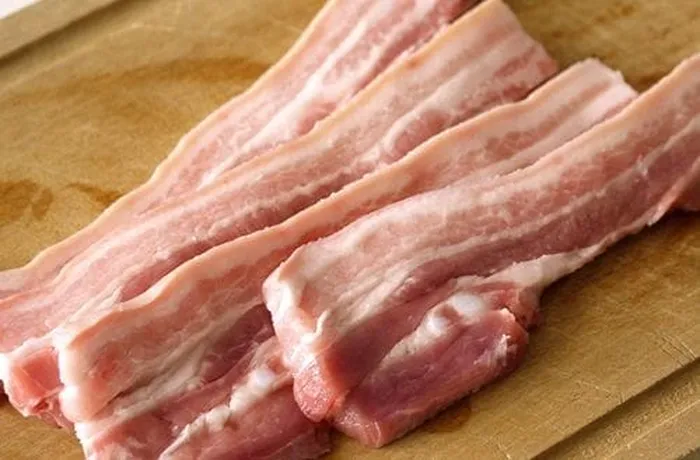
- Wrap each fillet in two slices of bacon, overlapping them slightly and tucking the loose ends underneath the fillet so they stay in place during roasting. Brush the tops of the bacon-wrapped fillets with the melted butter. Arrange them in the oiled baking dish without overlapping. Place in the preheated oven and roast for 15 minutes, or until the bacon is golden and the fish is opaque and flakes easily when tested with a fork.

- Remove from the oven and transfer the fillets to a serving plate immediately — leaving them in the hot baking dish continues cooking the fish. Drizzle the lemon juice evenly over all fillets and scatter the fresh parsley on top. Serve at once with white rice, creamy mashed potatoes, or roasted golden potatoes on the side.
Additional Tips
How to prevent the fish from drying out?
The bacon acts as a natural barrier against moisture loss, but two additional measures help. First, do not exceed 15 minutes in the oven at 200°C — hake cooks quickly, and an extra five minutes can take it from moist to dry. Second, brushing the bacon with melted butter before roasting adds a second layer of fat that helps the exterior brown without the interior losing moisture. Remove the dish from the oven as soon as the bacon is golden and the fish is opaque.
How to get the bacon to crisp evenly?
Use thin-cut smoked bacon and start the oven fully preheated at 200°C. Place the baking dish on the middle rack — too close to the bottom and the fish overcooks before the bacon crisps; too close to the top and the bacon chars before the fish is done. If the bacon is not as crispy as desired after 15 minutes, switch to the broiler function for 2 to 3 minutes while watching closely.
How to adapt this recipe for grilling?
The dish translates well to a hot grill or plancha. Brush the grill with oil, place the bacon-wrapped fillets directly over medium-high heat, and cook for 5 to 6 minutes per side. The grill gives the bacon a stronger char and smoke note that complements the mild hake. Use a fish spatula to turn the fillets gently — the bacon holds everything together but the fillet is delicate underneath.
Roasted Fish Recipes Comparison
| Recipe | Fish | Main flavor | Cook time |
|---|---|---|---|
| Merluza con tocino (this recipe) | Southern hake | Smoky bacon + thyme | 15 min at 200°C |
| Cancato | Hake or salmon | Longaniza + tomato + cheese | 20 min covered |
| Corvina al horno | Corvina | Lemon + white wine + herbs | 25 min at 180°C |
| Corvina a la plancha | Corvina | Lemon + olive oil + garlic | 4 min per side |
Frequently Asked Questions (FAQs)
1. Can I use frozen hake for this recipe?
Yes, frozen hake works well, but it must be completely thawed before cooking. Remove it from the freezer the night before and let it thaw in the refrigerator. Once thawed, pat the fillets dry with paper towels — removing excess surface moisture is essential for the bacon to crisp and for the fish to roast rather than steam in its own liquid.
2. What type of bacon works best?
Smoked bacon cut into thin slices is the best choice. Thin slices wrap more tightly around the fillet and crisp up during the 15-minute roasting time without overcooking the fish. Thick-cut bacon may not fully render by the time the hake is done. Regular cured bacon without added sugar is recommended — honey-cured or maple varieties can burn at 200°C before the fish is cooked through.
3. What herbs can I use instead of thyme?
Rosemary, oregano, and merkén (Chilean smoked chili) are the best substitutes. Rosemary gives a more assertive herbal note; oregano is milder and more Mediterranean in character; merkén adds a gentle smoky heat that complements both fish and bacon. If using fresh herbs, use three times the volume of dried (one teaspoon dried equals one tablespoon fresh).
4. What side dishes pair best with merluza con tocino?
White rice absorbs the butter and lemon cooking juices and is the most traditional accompaniment. Creamy mashed potatoes are the richest pairing and complement the smoky bacon well. Roasted golden potatoes and a fresh green salad with lemon dressing are lighter options. Avoid heavy, strongly flavored sides that compete with the delicate fish.
5. How long does it keep and how should I reheat it?
Stored in an airtight container in the refrigerator, the cooked dish keeps for up to 2 days. Reheat in a preheated oven at 180°C for 8 to 10 minutes — this re-crisps the bacon effectively. A covered skillet over medium-low heat for 5 minutes also works. Avoid the microwave: it softens the bacon and can make the fish rubbery.
What Is Chilean Merluza Asada con Tocino?
Merluza asada con tocino is a home-style Chilean oven dish that pairs the mild, firm flesh of southern hake with smoked bacon in a simple preparation designed to keep the fish moist. It belongs to the tradition of Chilean coastal cooking in which Pacific fish are combined with cured pork products — a combination that appears throughout the country’s regional cuisine, from the cancato of the Chiloé archipelago to the choriqueso of Punta Arenas. The dish requires no marinade and no sauce, relying instead on the fat from the bacon, a herb paste, and a final dressing of lemon juice and parsley to build its flavor in three distinct layers.
History of Merluza in Chilean Cooking
Merluza austral (Merluccius australis) has been caught in Chilean waters since at least the mid-twentieth century, when industrial trawling expanded access to deep-water species along the Patagonian shelf. Unlike many Chilean fish preparations that developed in specific regional contexts, merluza con tocino appears across the country as a generic home recipe — a result of the fish’s wide distribution through supermarkets and fish markets and its reputation as an economical and versatile protein. The pairing with bacon reflects a broader pattern in Chilean cooking where smoked and cured pork products are used to add richness and depth to mild-flavored fish and vegetables that might otherwise require more elaborate sauces.
Did You Know?
Chile is one of the world’s leading producers of hake, with the southern hake (merluza austral) and the common hake (merluza común) both commercially fished in Chilean waters. The southern species, caught primarily in the XII Región de Magallanes and further north along the Patagonian coast, is prized for its firmer texture compared to the common variety. Chile’s hake fisheries operate under quota management systems administered by SERNAPESCA, the national fisheries authority, which sets annual catch limits to maintain sustainable stock levels. The fish is exported primarily to Spain, Brazil, and France, where it is also widely consumed.