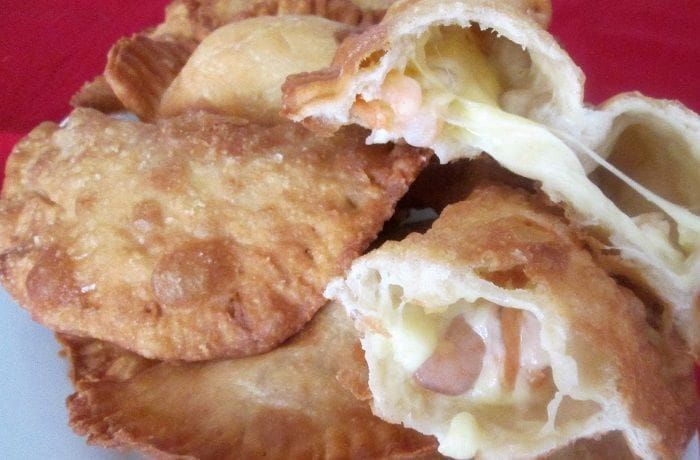
Chilean shrimp and cheese empanadas are made by preparing a soft wheat dough with lard, warm milk, and baking powder, filling circles of rolled dough with flash-cooked shrimp, chunks of mantecoso cheese, and merkén, sealing the edges, and baking at 200°C for 15 minutes or frying in oil at 160°C until golden. The result is a bubbling, crispy pastry with molten cheese and tender shrimp inside. Prep takes 40 minutes, cooking 30 minutes, and the recipe serves 6.
Empanadas de camarón queso occupy a specific place in Chilean seafood cooking — they are the classic coastal empanada filling wherever fresh shrimp is accessible, and they appear on the menus of restaurants from Arica to Punta Arenas. The combination of the mild, fatty melt of queso mantecoso with the sweetness of briefly cooked shrimp is technically straightforward but produces a result that consistently outperforms its simplicity. The addition of merkén — the smoked Mapuche chili that has become Chile’s defining spice — bridges the richness of the cheese and the brininess of the shrimp with a warm, aromatic smokiness.
How to Make Chilean Shrimp and Cheese Empanadas?
The key technical step in this recipe is the shrimp: it must only receive a brief flash of heat in the pan — not be fully cooked — because it will continue cooking inside the sealed empanada during baking or frying. Fully cooked shrimp that goes into the filling will become rubbery and dry by the time the dough is done. The cheese should be cut into generous chunks rather than grated, so that it forms molten pockets rather than dispersing uniformly through the filling. The dough should be thin (2–3 mm) and rested, which makes rolling easier and produces a crispier result.
Nutritional Information
Each serving of Chilean shrimp and cheese empanada contains approximately 450 calories, 22 g of protein, 25 g of total fats (15 g saturated), 35 g of carbohydrates (5 g of sugars), and 800 mg of sodium. The fried version has slightly higher fat content than the baked; the air fryer version reduces total fat by approximately 30–40% compared to traditional frying.
Homemade Chilean Shrimp and Cheese Empanadas Recipe
Prep Time: 40 minutes
Cook Time: 30 minutes
Servings: 6
Ingredients
- 700 g queso mantecoso (or young gouda or full-fat mozzarella)
- 500 g fresh shrimp, peeled and deveined
- 3 cups all-purpose wheat flour
- 2 tablespoons lard (manteca), melted
- 100 ml warm milk
- 100 ml warm water
- 1 teaspoon salt
- 1 teaspoon baking powder
- 1 egg yolk (for egg wash)
- 2–3 spring onions (cebollines), finely chopped
- Merkén (smoked Mapuche chili), to taste
- Salt and pepper, to taste
- Vegetable oil for frying (or olive oil for baking)
Instructions
- Make the dough: Sift the flour into a large bowl and open a well in the center. Add the melted lard, warm milk, salt, and baking powder. Mix from the center outward until the ingredients begin to combine, then add the warm water gradually while continuing to mix. Knead by hand on a clean surface until the dough is smooth, elastic, and does not stick to your fingers — approximately 8 minutes of active kneading. The dough should spring back slightly when pressed.
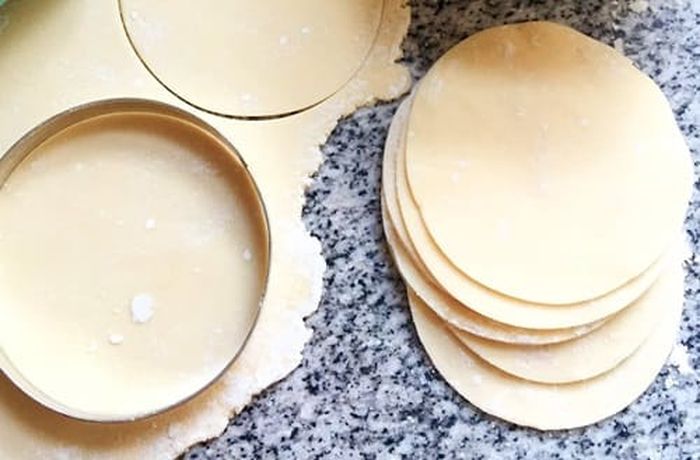
- Rest and cut the dough: Cover the dough with a clean kitchen towel and rest for 10 minutes. Transfer to a lightly floured surface and roll out to approximately 2–3 mm thickness using a rolling pin. Cut circles using a plate or round cutter of 15–20 cm diameter as a guide. Re-roll the offcuts to use all the dough. You should obtain 6 large circles.
- Cook the shrimp filling: Heat a thin film of vegetable oil in a medium skillet over medium-low heat. Add the chopped spring onions and sauté for about 5 minutes, stirring occasionally, until lightly golden and soft. Season with merkén to taste, plus salt and pepper. Add the peeled shrimp and give them a brief flash of heat — 60 to 90 seconds maximum, stirring once — just until they begin to turn pink at the edges. Remove from the heat immediately. They will finish cooking inside the empanada.
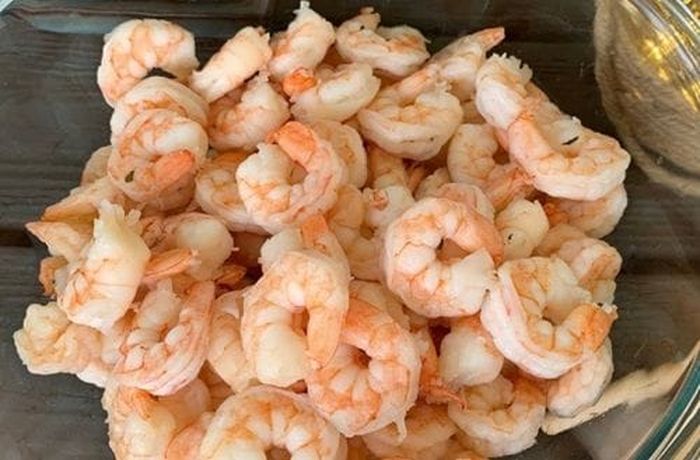
- Assemble the empanadas: Allow the shrimp filling to cool completely. Lay the dough circles on a clean surface. Moisten the outer edge of each circle with a thin film of water, applied with wet fingers, to ensure the seal holds. Place a portion of the cooled shrimp in the center of each circle and add a generous piece of mantecoso cheese alongside it — about 100 g of cheese per empanada. Fold the dough in half over the filling to form a half-moon. Press the edges firmly together with your fingers, then crimp with the back of a fork to reinforce the seal.
- Bake or fry: For baking: preheat the oven to 200°C (392°F) for at least 10 minutes. Place the empanadas on a parchment-lined baking sheet, brush each one generously with egg yolk mixed with a splash of water, and bake for 15 minutes or until lightly golden. For frying: heat vegetable oil in a deep pan over medium heat to 160°C (320°F) — test with a small piece of dough; it should sizzle and rise to the surface immediately.

- Fry and serve: Lower the empanadas gently into the hot oil one at a time, without overlapping. Fry for 2 minutes per side until evenly golden. Work in batches if necessary. Transfer to a plate lined with absorbent paper to drain briefly. Serve immediately while still hot, with a glass of Chilean white wine or pebre on the side.
Additional Tips
Use Mantecoso — Not Mozzarella — for the Authentic Pull
While mozzarella produces an acceptable melt in shrimp empanadas, queso mantecoso behaves differently in a critical way: it is softer at room temperature, which means it begins to melt earlier in the cooking process and reaches a fully liquid, silky state before the dough is fully done. The result is a more homogeneous molten interior with no stringy resistance — the cheese literally flows around the shrimp. If mantecoso is not available, the closest substitute is a young, unaged gouda at room temperature, which replicates the high-fat, low-melting-point profile reasonably well.
Add a Few Drops of Lemon to the Shrimp Filling
A squeeze of fresh lemon juice added to the shrimp filling after the flash of heat — approximately half a teaspoon per 500 g of shrimp — provides an acid counterpoint that cuts through the richness of the cheese and lifts the sweetness of the shrimp. This is a widely used variation in Chilean coastal home cooking. Add the lemon juice after removing the pan from the heat, not during cooking: citric acid added to hot shrimp causes immediate surface tightening, which defeats the purpose of the brief flash of heat.
The Oil Temperature Is Non-Negotiable for Frying
Frying below 160°C produces empanadas that absorb oil rather than crisping — the dough becomes greasy and soft before it sets. Frying above 180°C risks burning the exterior before the cheese has fully melted and the shrimp has finished cooking inside. A kitchen thermometer is strongly recommended. If a thermometer is not available, test with a small scrap of dough: at the correct temperature it should sizzle immediately, rise to the surface within 10 seconds, and turn golden within 60 seconds. Adjust the burner between batches to maintain temperature as cool batter lowers the oil temp.
| Component | Standard | Substitute | Notes |
|---|---|---|---|
| Cheese | Queso mantecoso | Young gouda, full-fat mozzarella | Mantecoso melts earliest and most fluidly |
| Shrimp | Fresh, peeled, deveined | Frozen (thawed and dried thoroughly) | Dry frozen shrimp very well — excess water cracks the dough |
| Fat (dough) | Lard (manteca) | Butter, vegetable shortening | Lard produces a more tender, flaky crumb than butter |
| Heat | Merkén (smoked chili) | Ají paste, smoked paprika | Merkén is the traditional Patagonian-Chilean smoky note |
Frequently Asked Questions (FAQs)
What cheese melts best in Chilean shrimp empanadas?
Queso mantecoso — it has high fat content and a low melting point that produces a silky, liquid interior when you bite in. Unavailable outside Chile? Use young unaged gouda or full-fat mozzarella. Avoid aged or low-fat cheeses.
Can I use frozen shrimp for this recipe?
Yes, but thaw completely and pat extremely dry. Water released by wet frozen shrimp steams inside the empanada, weakens the seal, and causes bursting. Never defrost in hot water — it par-cooks the exterior.
How do I prevent the empanadas from bursting in the oil?
Three precautions: moisten the dough edges thoroughly before sealing, do not overfill (leave room for cheese expansion), and pin with a toothpick if the seal feels weak. Frying at below 160°C also increases burst risk.
Can Chilean shrimp and cheese empanadas be made in an air fryer?
Yes — 180°C for 10–12 minutes with an egg yolk brush, turning once at the halfway point. Less fat than the fried version, uniform golden color, and comparable flavor.
Wine Pairing for Shrimp and Cheese Empanadas
Both shrimp and melted cheese pair naturally with medium-bodied white wines with good acidity. A Chilean Chardonnay or Sauvignon Blanc with brief oak aging has the structural weight to stand alongside the richness of the mantecoso without being overpowered by the fat, while its acidity cuts through the cheese and brightens the sweetness of the shrimp. A unoaked Sauvignon Blanc works equally well for a leaner pairing. Cold sparkling wine — Chilean cava or espumante — is also excellent, as the bubbles and acid act as palate cleansers between bites.
What Are Chilean Shrimp and Cheese Empanadas?
Chilean shrimp and cheese empanadas are individual pastries made with a lard-enriched wheat dough filled with briefly cooked shrimp, chunks of melted queso mantecoso, and merkén, then sealed and either baked or fried until golden. They belong to the broader category of Chilean empanadas but represent specifically the coastal seafood tradition: unlike empanadas de pino (the national standard with beef, hard-boiled egg, and olive), the shrimp-and-cheese version reflects Chile’s relationship with the Pacific — a coastline of over 4,000 km that gives Chilean cooks access to some of the most diverse and abundant seafood in the world.
History of Shrimp and Cheese Empanadas in Chile
The empanada arrived in Chile from Spain during the colonial period of the sixteenth and seventeenth centuries, adapting quickly to local ingredients and regional food cultures. Along the Chilean coast, particularly from Coquimbo southward through the regions where Pacific shrimp is commercially fished, the seafood empanada emerged as a natural evolution of the continental filling tradition. The shrimp-and-cheese combination became prominent in the twentieth century as refrigerated transport made fresh shrimp available inland and as queso mantecoso — originally a specialty of the south — spread across the national market. By the late twentieth century, empanadas de camarón queso had become a standard item in Chilean restaurants, fish markets, and home cooking, particularly during the warm summer months and on Chilean national holiday menus.
Did You Know?
Chile’s Pacific coast is one of the most productive fishing zones in the world because of the Humboldt Current — a cold, upwelling ocean current that runs northward along the South American Pacific coast from Antarctica. The upwelling brings cold, nutrient-rich water from the deep ocean to the surface, fueling explosive plankton growth that supports the entire marine food chain from anchovies to tuna to spiny lobsters to the shrimp used in this recipe. Chile is consistently among the top five seafood-producing nations globally, and shrimp (camarón) from the Pacific coast of Antofagasta and Atacama regions — where the cold Humboldt water is most pronounced — is considered among the finest in South America.