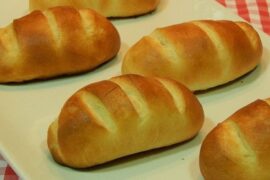
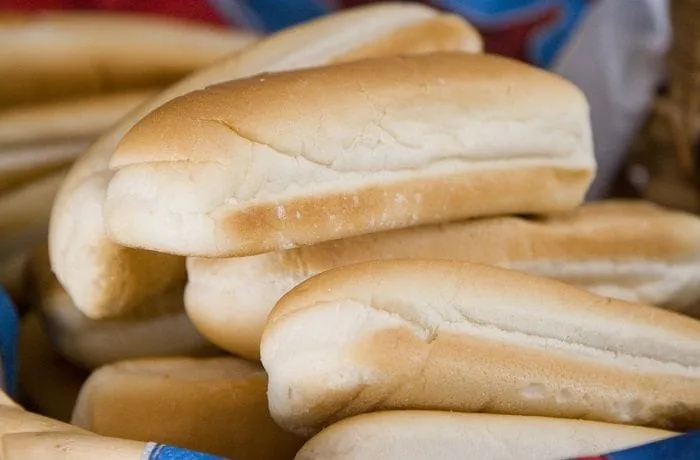
Chilean pan copihue, also called pan de completo, is the soft, elongated bread used for the completo — Chile’s iconic hot dog piled with avocado, chopped tomato, and mayonnaise. Made from a yeast dough enriched with milk, butter, and egg, each loaf bakes in 15 minutes and yields a crumb tender enough to absorb condiments without turning soggy. The name copihue refers to the Chilean national flower, whose elongated shape the bread resembles.
The dough requires two rises — a 40-minute first rise after kneading and a 30-minute second rise after shaping — which develop the open crumb structure and the mild yeast flavor that set this bread apart from crusty rolls like marraqueta. Covering the loaves with a cloth immediately after baking keeps the crust soft throughout cooling, which is the standard technique in Chilean bakeries.
How to Make Chilean Pan Copihue?
The key to a soft, long-lasting pan copihue is developing a strong gluten network during kneading. Knead for a full 10 minutes — the dough should stretch without tearing and spring back slowly when poked. Under-kneaded dough produces a dense, crumbly crumb that collapses when sliced for a sandwich. A well-kneaded dough holds its elongated shape through the second rise and the bake.
Use warm milk (around 40°C) to melt the butter and activate the yeast without cooking it. If the milk is too hot, it kills the yeast; if too cold, the rise takes much longer. A pinch of sugar added to the yeast and warm water activates the fermentation and confirms that the yeast is live before you commit the full batch of flour to the process.
Nutritional Information
Per serving (one loaf, approximately 160g baked): approximately 438 kcal, 12g protein, 10g total fat (6g saturated), 72g carbohydrates, 4g sugars, 380mg sodium, 2g fiber. The caloric content comes mainly from the refined flour and the enrichment from butter, milk, and egg. A whole wheat version using 50% whole wheat flour increases fiber to approximately 5g per serving and reduces the glycemic impact of the carbohydrates.
Homemade Chilean Pan Copihue Recipe
Prep time: 30 minutes | Rising time: 70 minutes | Cook time: 15 minutes | Servings: 6 loaves
Ingredients
- 700g bread flour (all-purpose flour also works)
- 350ml whole milk
- 60g unsalted butter, cut into pieces
- 20g sugar
- 10g dry active yeast (or 30g fresh yeast)
- 1 teaspoon salt (approximately 5g)
- 1 large egg
- 50ml warm water (for activating the yeast)
Instructions
- Dissolve the yeast and a pinch of the sugar in 50ml warm water (38–40°C). Stir and let stand for 5 minutes until the mixture turns foamy. If no foam develops, the yeast is inactive — discard and start with a fresh packet.
- Warm the milk in a small saucepan over low heat. Add the butter pieces and stir until fully melted. Remove from heat and let cool to around 38°C — warm enough to activate the yeast but not hot enough to kill it.
- Combine the flour, remaining sugar, and salt in a large bowl. Make a well in the center. Pour in the warm milk-butter mixture and the activated yeast. Mix with your hands or a wooden spoon until a rough, shaggy dough forms. Add the egg and continue mixing until fully incorporated.
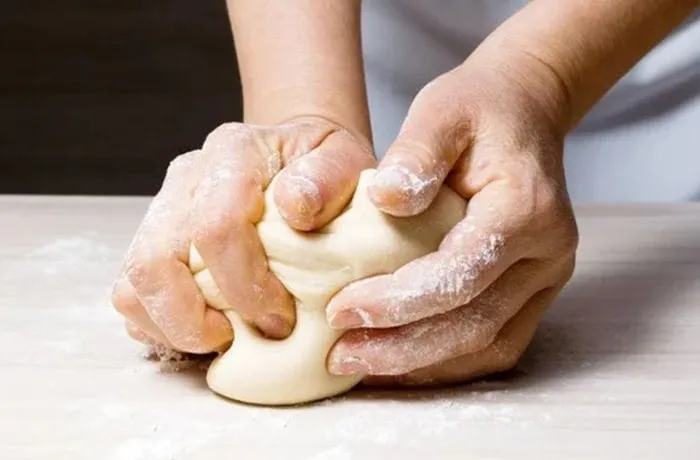
- Turn the dough out onto a lightly floured surface. Knead firmly for 10 minutes, pushing the dough away with the heel of your hand and folding it back over itself. The finished dough should be smooth, slightly tacky, and elastic — it should stretch into a thin, translucent sheet (the windowpane test) without tearing.
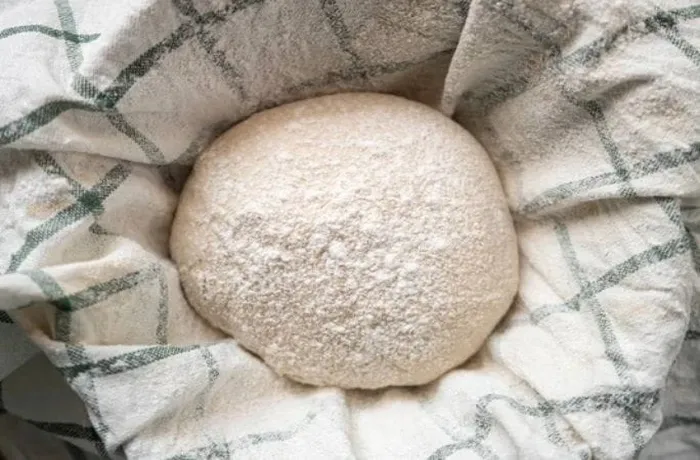
- Shape the dough into a ball. Place in a lightly oiled bowl, turning once to coat the surface. Cover with plastic wrap or a clean cloth and let rise in a warm place (24–28°C) for 40 minutes, or until roughly doubled in volume.
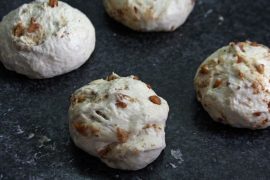
- Punch down the risen dough to release the gas. Turn out onto a lightly floured surface and divide into 6 portions of approximately 80g each. For even loaves, use a kitchen scale.
- Shape each portion into an elongated loaf 14–16 cm long. Roll the dough under your palms, applying light pressure to taper the ends slightly. The loaf should be uniform in thickness so it bakes evenly.
- Place the shaped loaves on a parchment-lined baking sheet, spacing them at least 5 cm apart. Cover loosely with a cloth and let rise for 30 minutes, until visibly puffed. Preheat the oven to 180°C (350°F) during this second rise.
- Bake for 15 minutes until the loaves are lightly golden on top and the undersides sound hollow when tapped. Do not overbake — a pan copihue that has colored too deeply will have a hard crust that does not soften properly during cooling.
- Remove from the oven. Cover the loaves immediately with a clean, dry cloth and leave to cool completely. This traps steam and keeps the crust soft and pliable — the defining texture of a good pan copihue.
Additional Tips
How to use the tangzhong method for an even softer crumb
Tangzhong is a Japanese technique — now used by Chilean bakers for pan copihue — that involves cooking a small portion of the flour and liquid together before adding them to the main dough. Mix 35g of the flour with 175ml of the milk in a small saucepan over medium heat, stirring constantly, until the mixture thickens to a paste (around 65°C). Remove from heat and let cool to room temperature, then add it to the remaining ingredients as normal. The cooked starch retains more moisture during baking and slows staling, producing a loaf that stays soft for 24–36 hours instead of the standard 12–18 hours.
How to convert between dry, instant, and fresh yeast
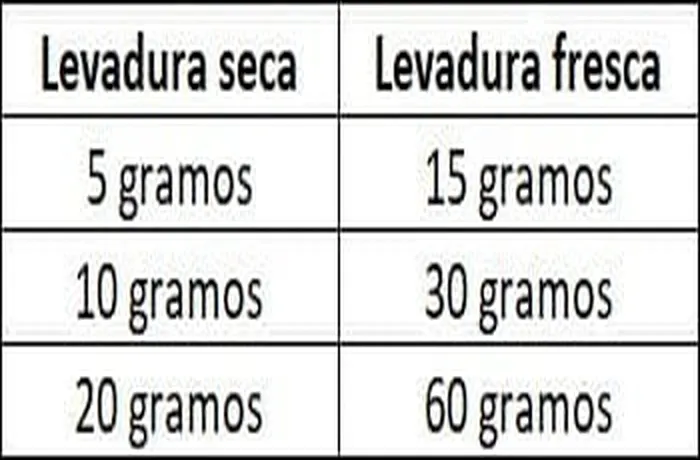
The recipe calls for 10g of dry active yeast (granulated yeast that requires rehydration in warm water before use). If using instant yeast (also called rapid-rise or bread machine yeast), reduce to 7g and add it directly to the flour without dissolving in water first. If using fresh compressed yeast, use 30g and dissolve it in the warm water the same way as dry active yeast. In all cases, the rising times remain the same — instant yeast may rise slightly faster in warm conditions.
How to test gluten development without a thermometer
The windowpane test is the standard check for kneading completion in any enriched dough. Take a small piece of dough — about the size of a golf ball — and stretch it slowly between your thumbs and forefingers, working from the center outward. If the dough stretches into a thin, translucent membrane before tearing, the gluten is fully developed and kneading is complete. If it tears immediately or shows thick, opaque patches, knead for 2 more minutes and test again. Under-kneaded dough is the most common cause of dense, gummy pan copihue.
| Ingredient | Standard (this recipe) | Substitute | Effect |
|---|---|---|---|
| Whole milk | 350ml | Water + 15g extra butter | Slightly less tender, drier crumb |
| Unsalted butter | 60g | Neutral vegetable oil | Less rich flavor, slightly chewier |
| Bread flour | 700g | 350g bread + 350g whole wheat | Denser, earthier, higher fiber |
| Dry active yeast | 10g | 7g instant yeast or 30g fresh | Same rise, instant yeast slightly faster |
Frequently Asked Questions (FAQs)
1. Can I substitute water for milk in pan copihue?
Yes, but the result will be noticeably less tender. Milk contributes fat, lactose, and proteins that soften the crumb and help the crust stay pliable after baking. A water-based dough produces a slightly chewier, drier bread that stales faster. If using water, add an extra 10g of butter to partially compensate for the missing fat from the milk.
2. Can I use whole wheat flour for pan copihue?
Yes, up to 50% whole wheat flour is workable. Replace half the bread flour with whole wheat and add 15–20ml more liquid, since whole wheat flour absorbs more water. The result will be denser and slightly earthier in flavor. Beyond 50% whole wheat, the gluten network becomes too weak to hold the elongated shape and the loaves will spread flat rather than rise upward.
3. How do I get a soft, smooth crust on pan copihue?
The key step is covering the loaves with a clean dry cloth immediately after they come out of the oven. As the bread cools, steam trapped under the cloth softens the crust from the outside. Do not use plastic wrap or an airtight container — the trapped moisture makes the crust soggy rather than soft. This is the standard technique in Chilean bakeries and it makes a significant difference to the final texture.
4. How long does pan copihue stay fresh?
Pan copihue is best on the day it is baked. Stored at room temperature in a cloth bag or wrapped in paper (never plastic), it stays acceptable for up to 24 hours. After that the crumb dries noticeably. To extend freshness, freeze the fully cooled loaves the same day in a zip-lock bag — they reheat well at 160°C for 8 minutes. Do not refrigerate; cold temperatures accelerate staling in all yeasted breads.
5. What is the difference between pan copihue and marraqueta?
Pan copihue and marraqueta are two entirely different Chilean breads for different sandwiches. Marraqueta is a crusty, chewy roll with a hard crust and a deep X-shaped score — used for chacareros, churrascos, and lomitos, where the firm crust holds up to heavy fillings. Pan copihue is an elongated, soft, fluffy bread with a thin, pliable crust — used exclusively for the completo (Chilean hot dog) and sandwiches where condiments like avocado and mayonnaise must be absorbed without the bread going soggy. Substituting one for the other changes the eating experience entirely.
What Is Pan Copihue (Pan de Completo)?
Pan copihue, also called pan de completo, is the elongated, soft roll used as the bread for the completo — Chile’s most consumed street food, a hot dog topped with avocado, diced tomato, and mayonnaise. The name copihue refers to the Chilean national flower (Lapageria rosea), a red bell-shaped flower whose elongated form the bread resembles. Pan copihue is an enriched yeasted bread, meaning it contains fat (butter), sugar, and egg in addition to the basic flour-water-salt-yeast combination of lean doughs. These enriching ingredients produce a soft, pillowy crumb and a pliable crust that does not split or crumble under sandwich fillings.
History of Chilean Completo Bread
Hot dog bread in its modern elongated form originates from the late nineteenth century in the United States, where vendors at baseball parks and street fairs needed a practical container for the sausage that was easy to hold and eat standing up. The format reached Chile in the early twentieth century as part of broader culinary contact with North American and European food culture. Chilean entrepreneur Eduardo Bahamondes is credited with popularizing the completo at his Santiago establishment Quick Lunch Bahamondes in the 1920s, which introduced the combination of hot dog, avocado, tomato, and mayonnaise that defines the Chilean completo today. Chilean bakers adapted the bread to local preferences — an enriched, softer dough than the American original — and pan copihue gradually standardized into its current form across Chilean bakeries during the mid-twentieth century.
Did You Know?
Chile consumes approximately 2.5 billion completos per year, making it one of the highest per-capita hot dog consumption countries in the world. The completo dinámico — the version with avocado, tomato, and mayonnaise — is so identified with Chilean culture that the word “completo” used alone in Chile always refers to this specific combination. The bread is called “copihue” after Chile’s national flower (Lapageria rosea), declared Chile’s national flower by law in 1977. The copihue flower, native to the temperate rainforests of southern Chile, has been used as a national symbol in official contexts since the nineteenth century.