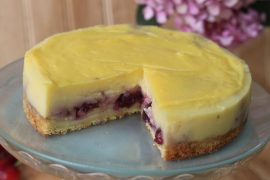

Chilean crumb kuchen (kuchen de migas) is a two-layer buttery streusel cake with a pastry cream filling — the same crumb dough pressed into the base, filled, and covered with the remaining crumble, then baked for 45 minutes. Each serving provides approximately 450 calories.
Popular especially in southern Chile, where kuchen is an integral part of the afternoon once tradition, this recipe produces a crumbly, golden cake with a creamy center that can be adapted with fruit or nut fillings.
Contents
How to Make Crumb Kuchen?
The defining technique of kuchen de migas is the crumb dough itself: butter, flour, sugar, and egg worked by hand until the mixture resembles coarse, sandy crumbs. Half the dough forms the base, which is baked first to set before the filling is added; the remaining crumbs go on top and brown during the second bake. The key is not to overwork the dough — the coarser the crumb, the better the final texture.
Nutritional Information
Each serving of crumb kuchen contains approximately 450 calories, 50 g of carbohydrates, 22 g of fats, 5 g of proteins, 1 g of fiber, 20 g of sugars, and 150 mg of sodium.
Homemade Crumb Kuchen Recipe
Prep Time: 20 minutes
Baking Time: 45 minutes
Servings: 6
Ingredients
- 300 g wheat flour
- 200 g pastry cream (crema pastelera)
- 125 g butter
- 100 g powdered sugar
- 1 egg
- 1 teaspoon baking powder
- ¼ teaspoon salt
- Ground cinnamon
Instructions
- Preheat the oven to 200°C (392°F) for at least 10 minutes.
- In a large bowl, sift together the flour, baking powder, powdered sugar, and salt. Mix with a wooden spoon to combine.
- Add the egg and warm melted butter. Work the mixture with your hands until it has a coarse, sandy crumb texture. Do not overwork — stop as soon as no dry flour remains. Set aside.
- Grease a 23 cm round kuchen pan with butter. Press half of the crumb mixture evenly across the base. Bake for 15 minutes, then remove and allow to cool to room temperature.
- Spread the pastry cream evenly over the cooled base, smoothing it gently with a spatula. Distribute the remaining crumb mixture over the filling to cover it completely.
- Return to the oven and bake for a further 30 minutes, or until the surface is golden brown. Remove from the oven, dust with cinnamon and powdered sugar to taste, and rest for 5 minutes before unmolding. Serve with coffee or vanilla ice cream.
Additional Tips
Use warm melted butter — not hot, not cold
The temperature of the butter is critical to the crumb texture. Hot butter melts the sugar and makes the dough greasy rather than crumbly. Cold or solid butter does not distribute through the flour evenly and produces a dough that is too dry to hold together when pressed into the pan. Melt the butter and allow it to cool for 5 minutes before adding it to the dry ingredients — it should feel warm to the touch but not steam when poured.
Handle the dough as little as possible to keep the crumb coarse
The characteristic sandy, crumbly texture of kuchen de migas comes from minimal handling. Once the butter and egg are incorporated and no dry flour remains, stop mixing. Squeezing or kneading the mixture activates the gluten in the flour and produces a denser, more bread-like texture rather than the loose, crumbly topping the recipe is known for. If the dough feels too sticky to crumble over the filling, refrigerate it for 10 minutes before use.
Cool the base completely before adding the filling
Adding the pastry cream to a warm base softens the partially baked dough and causes the filling to sink unevenly into the crust. The 15-minute pre-bake sets the structure of the base layer; cooling it fully before adding the cream ensures a clean separation between crust and filling in the finished kuchen. If you are short on time, place the baked base in the refrigerator for 5 minutes rather than waiting at room temperature.
| Ingredient | Substitution and result |
|---|---|
| Pastry cream | Ricotta + powdered sugar + vanilla — lighter texture; works especially well with fresh fruit fillings |
| Powdered sugar | Caster (superfine) sugar — slightly coarser crumb texture; same sweetness level |
| Butter | Cold margarine — less rich flavor; workable substitute if butter is unavailable |
| Wheat flour | Half wheat / half almond flour — nuttier flavor and slightly denser crumb; reduces gluten development |
| Ground cinnamon | Cardamom or vanilla powder — different aromatic profile; both are common regional variations in southern Chile |
Frequently Asked Questions (FAQs)
1. What is the difference between kuchen de migas and other Chilean kuchens?
Kuchen de migas is defined by its crumb dough (migas), which serves as both the base and the topping. Most other Chilean kuchen varieties use a yeasted dough or a firmer shortcrust pastry for the base, with a separate crumble or glaze on top. In kuchen de migas, the same mixture — flour, butter, sugar, egg — is pressed into the base, partially baked, and then crumbled over the filling for the second bake. The result is a softer, sandier texture throughout compared to kuchens with a firmer pastry base.
2. Can I use a different filling instead of pastry cream?
Yes. The crumb dough works with a wide range of fillings. Apple compote (manzana) and strawberry jam are the most common alternatives in southern Chile. Fresh berries, preserved cherries, cream cheese sweetened with sugar and vanilla, and manjar (dulce de leche) are all used regionally. The filling should be fairly thick — runny fillings will absorb into the base layer during the second bake and compromise the texture.
3. Why does the base need to bake before adding the filling?
The pre-bake sets the structure of the crumb base so it can support the weight and moisture of the filling without becoming soggy. Without this step, the filling softens the unbaked crumbs from below and the base layer loses its distinct texture, merging with the filling. The 15-minute bake creates a lightly golden, partially firm base that holds its shape when the cream is spread over it.
4. How do I store crumb kuchen?
Allow the kuchen to cool completely before storing. Cover with plastic wrap or place in an airtight container and refrigerate for up to 3 days. The crumb topping softens slightly after the first day due to the moisture from the pastry cream — this is normal and does not affect the flavor. For longer storage, freeze individual slices wrapped in plastic for up to 1 month; thaw at room temperature for 30 minutes before serving.
What Is Kuchen de Migas?
Kuchen de migas is the Chilean adaptation of the German Streuselkuchen — a cake topped with Streusel, a crumbly mixture of butter, flour, and sugar rubbed together by hand. The word “migas” (crumbs) directly translates the German “Streusel.” Unlike the original German version, which typically uses a yeasted base with Streusel only on top, the Chilean kuchen de migas uses the crumb dough for both layers, with the filling sandwiched between them. This double-crumb construction is one of the distinctive features of the Chilean kuchen tradition.
History of Kuchen in Southern Chile
Kuchen arrived in Chile with German immigrants who settled the Lake District — Valdivia, Osorno, Puerto Varas, Puerto Montt, and Frutillar — primarily between the 1840s and 1880s, following Chilean government programs that offered land in the southern frontier to European settlers. The immigrants brought their baking traditions directly from Germany, including Streuselkuchen, Pflaumenkuchen (plum cake), and Käsekuchen (cheesecake). Over the following generations, these recipes adapted to local ingredients: Chilean native fruits like murtillas, rosa mosqueta (rose hip), and local berries replaced European fillings, and the recipes became embedded in the once (afternoon tea) culture of southern Chile. In 2006, the Municipality of Valdivia formally declared kuchen part of the city’s cultural and gastronomic heritage. Today, kuchen de migas is available in virtually every panadería and café in the Araucanía, Los Ríos, and Los Lagos regions, and is strongly associated with southern Chilean identity.
Did you know?
The southern Chilean kuchen tradition is so established that the word “kuchen” has been fully adopted into Chilean Spanish — pronounced as written (“KU-chen”) and used without translation. Chilean kuchen varieties number in the dozens and include regional specialties that do not exist in Germany. The once con kuchen in the Lake District is considered one of Chile’s most distinctive regional food experiences and attracts culinary tourists from Santiago and abroad.