Versión en Español
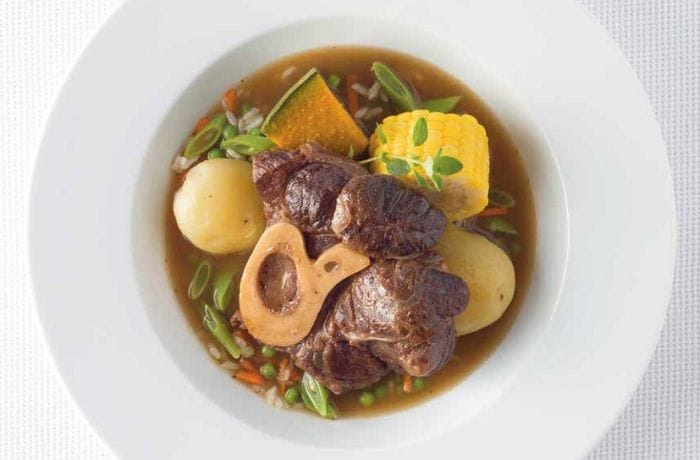
Chilean cazuela de osso buco is a clear-broth stew of 4 veal shanks seared and simmered with potato, pumpkin, corn, rice, green beans, and peas in 2.5 liters of water for 90 minutes — the bone marrow and collagen from the shank dissolve into the broth, giving it a body and richness no other cut produces. Each serving provides approximately 400 calories.
It is one of the most traditional dishes in Chilean home cooking, originally prepared on a wood-burning stove where the slow, even heat was ideal for the long shank cooking time, and now equally suited to a standard pot or pressure cooker.
How to Make Osso Buco Stew?
The defining characteristic of this cazuela is the osso buco cut itself: a cross-section of the shank that includes the cylindrical marrow bone surrounded by a ring of gelatinous connective tissue and lean meat. During the initial sear and the subsequent long simmer, the marrow softens inside the bone and gradually enriches the broth, while the collagen in the surrounding tissue breaks down and gives the liquid a slightly viscous, rounded quality. Vegetables are added in two stages — the longer-cooking ones (potato, pumpkin, corn) go in first, and the quicker ones (rice, green beans, peas) follow 15 minutes later — so everything finishes at the same moment.
Nutritional Information
Each serving of Chilean cazuela de osso buco contains approximately 400 calories, 38 g of carbohydrates, 12 g of fats, 35 g of proteins, 6 g of fiber, 8 g of sugars, and 600 mg of sodium.
Chilean Osso Buco Cazuela Recipe
Prep Time: 30 minutes
Cook Time: 60 minutes
Servings: 4
Ingredients
- 4 veal osso bucos (cross-cut shank, bone-in)
- 4 large potatoes, peeled and whole
- 4 pieces of pumpkin (zapallo)
- 4 pieces of corn on the cob
- 4 tablespoons white rice
- 2.5 liters hot water
- 2 garlic cloves, minced
- 1 onion, thinly sliced
- 1 carrot, cut into sticks
- 1 cup green beans, chopped
- ½ cup fresh peas, shelled
- ¼ red bell pepper, sliced into strips
- 1 tablespoon sunflower oil
- Dried oregano, salt, and pepper to taste
- Fresh cilantro to garnish
Instructions
- Heat the oil in a large, heavy pot over high heat. Season the osso bucos with salt and pepper. Sear for 2 to 3 minutes per side until a deep brown crust forms. Remove and set aside — do not skip this step, as the browning builds the base flavor of the broth.
- In the same pot over medium heat, add the sliced onion, carrot sticks, bell pepper strips, and minced garlic. Season with salt, pepper, and a pinch of dried oregano. Sauté for 3 to 4 minutes, stirring with a wooden spoon, until the onion softens.
- Add the whole potatoes and pour in the hot water. Bring to a boil, then return the seared osso bucos to the pot. Reduce to a steady simmer and cook for 20 minutes.
- Add the corn pieces and pumpkin. Adjust the water level if needed to keep everything submerged. Continue simmering over medium heat for 15 minutes.
- Add the rice, green beans, and peas. Stir gently to distribute. Cook for a further 15 minutes until the rice is tender and the vegetables are cooked through. Taste and adjust seasoning.
- Serve immediately in deep bowls, making sure each portion receives one osso buco, one potato, a piece of pumpkin, and a piece of corn. Garnish with freshly chopped cilantro. Encourage diners to scoop the marrow from the bone and stir it into their broth.
Osso Buco Cazuela in a Pressure Cooker
A pressure cooker reduces the total cooking time by roughly half — from 90 minutes to approximately 45 minutes. Sear the osso bucos first in the open pressure cooker over high heat as described in step 1, then add the sautéed vegetables, potatoes, and water. Seal and cook at high pressure for 20 minutes. Release the pressure carefully, open the lid, and add the corn and pumpkin. Reseal and cook for a further 8 minutes at high pressure. Release again, add the rice, green beans, and peas, and finish uncovered over medium heat for 10 minutes without pressure until the rice is cooked. The broth will be slightly more concentrated and the meat more tender than the open-pot version.
Additional Tips
Sear the osso bucos hard — it is not optional browning
The Maillard reaction that occurs when the shank surfaces hit the hot oil produces hundreds of flavor compounds that cannot be created by boiling alone. These compounds dissolve into the broth during the subsequent simmer, giving the cazuela its characteristic golden color and depth of flavor. The sear should take 2 to 3 minutes per side over high heat — the surface should be visibly dark brown, not grey. If your pot is not large enough to sear all four shanks without crowding, do it in two batches: crowding causes steaming instead of browning. Pat the osso bucos dry with paper towel before searing — surface moisture prevents browning.
Add vegetables in two stages — not all at once
The staggered addition is what allows every component to finish cooking simultaneously. Potatoes (20 minutes), pumpkin and corn (15 minutes), and rice with green beans and peas (15 minutes) each have different cooking times. Adding everything together results in either overcooked peas and rice or undercooked potato — one of the most common failures in cazuela preparation. If your potatoes are particularly large (over 200 g each), add them at the same time as the osso bucos rather than waiting for the sauté stage, to ensure they are fully cooked by the end.
The marrow is the prize — remind diners to use it
The cylindrical bone in each osso buco contains bone marrow — a dense, fatty, intensely flavored substance that softens during the long simmer into a buttery, spreadable consistency. By the time the cazuela is ready, the marrow slides out of the bone with gentle pressure from a small spoon. Stirring it directly into the broth immediately enriches and rounds the flavor of the entire bowl. In Chile, experienced diners will always tip the bone upright over their plate and use the long handle of a teaspoon to extract every bit. Osso buco without marrow is considered an incomplete experience.
| Ingredient | Substitution and result |
|---|---|
| Veal osso buco | Beef osso buco (cross-cut beef shank) — more widely available; stronger, deeper flavor; add 20 extra minutes of simmering time |
| Pumpkin (zapallo) | Butternut squash or sweet potato — closest substitutes in texture and sweetness; same cooking time |
| Corn on the cob pieces | Frozen corn kernels (1 cup) — equivalent flavor; skip the cob piece and add kernels together with the peas in the final stage |
| White rice | Fideos (thin pasta) or angel hair broken into 3 cm pieces — common Chilean variation; add in the last 10 minutes rather than 15 |
Frequently Asked Questions (FAQs)
1. What is the difference between cazuela and a regular stew?
Chilean cazuela is distinguished from most stews by its clear, broth-forward character: the liquid is not thickened with flour, starch, or reduction — it remains a clear, golden soup throughout the cooking process. The meat and vegetables sit in abundant broth and are served together in a deep plate, not on a plate with a reduced sauce. A regular stew (estofado) is typically denser, with less liquid, a thicker sauce, and smaller-cut ingredients. Cazuela uses whole or large-cut vegetables and a single large piece of bone-in meat per serving — presentation is part of its identity.
2. Can I use beef osso buco instead of veal?
Yes — beef osso buco (cross-cut beef shank) is a perfectly valid and more economical substitute. The key differences are flavor intensity (beef is stronger and more assertive than veal) and cooking time (beef shank requires approximately 20 additional minutes of simmering to reach the same tenderness as veal). The broth will also be darker and more robust. In practice, most Chilean households use beef rather than veal for everyday cazuela, reserving veal for special occasions. The preparation is identical — only the timing changes.
3. How do I know when the cazuela is done?
Three simultaneous checks: the potato should be fully tender when pierced with a knife (no resistance at the center); the rice should be cooked through but not mushy; and the osso buco meat should pull away easily from the bone at the edges when pressed with a spoon. The marrow inside the bone will have softened from solid to a gelatinous, almost liquid consistency — tipping the bone should cause it to slide toward the opening. If the potato is done but the rice is not, add a splash of hot water and cook uncovered for 5 more minutes.
4. Can I make Chilean cazuela de osso buco in a pressure cooker?
Yes — and the pressure cooker version is common in Chilean home cooking for weeknights when the 90-minute open-pot cooking time is impractical. The total active cooking time drops to approximately 45 minutes. The key is adding vegetables in two pressure cycles rather than one, to prevent the quicker-cooking ones (peas, green beans, rice) from disintegrating. The full pressure cooker instructions are described in the section above.
What Is Chilean Cazuela de Osso Buco?
Chilean cazuela is the country’s quintessential one-pot meal — a clear-broth stew in which a large piece of bone-in meat simmers with whole vegetables until the broth becomes naturally enriched by the collagen and marrow released from the bone. The osso buco version is considered one of the finest expressions of the dish because the cross-cut shank provides two distinct sources of richness: the gelatinous connective tissue surrounding the meat, which dissolves into the broth during cooking, and the bone marrow inside the cylindrical bone, which softens to a buttery consistency and can be scooped out and stirred into the bowl. Veal osso buco is also an excellent source of lean protein, zinc (which supports immune function and muscle repair), and iron. Unlike the Italian braised osso buco in wine and tomato, the Chilean cazuela version is broth-based and vegetable-rich — it functions simultaneously as a soup and a main course, served in a deep plate with the broth, meat, and vegetables all present together.
History of Chilean Cazuela
The cazuela has its roots in both Mapuche indigenous cooking and Spanish colonial cuisine. The Mapuche used earthenware cooking vessels — called “cazuelas” by Spanish colonizers from the Arabic “qas’a” (bowl) — to slow-cook meats and vegetables over open fire, producing one-pot preparations that already resembled the modern dish. Spanish settlers brought their own broth-stew tradition (the olla podrida and cocido) and the full range of Old World aromatics (garlic, oregano, onion), which merged with Mapuche cooking technique and the New World vegetable repertoire (potato, pumpkin, corn) during the colonial period. The result was the cazuela as it is known today — a Chilean synthesis of two cooking traditions, incorporating all the seasonal vegetables of the Chilean central valley into a single pot. The use of osso buco specifically for cazuela became established as an economical choice: the shank cut required long cooking (making it cheaper than prime cuts) but produced an exceptionally rich broth that made it prestigious for this preparation. The wood-burning stove (cocina a leña) was the original domestic cooking method for cazuela in rural Chile, where the slow, steady heat was ideal — the modern gas and electric stove versions simply replicate that sustained medium-low heat over time.
Did you know?
Osso buco means “bone with a hole” in Italian — a direct reference to the hollow marrow cavity inside the cross-cut shank bone. Despite the Italian name, the cut has been sold and cooked in Chile under this name for over a century, likely via the significant Italian immigration to Chile in the late 19th and early 20th centuries (particularly to the Valparaíso region and the Chilean south). Chilean butchers cut the shank slightly thicker than the Italian standard — typically 4 to 5 cm versus the Italian 3 to 4 cm — because the cazuela preparation, with its longer cooking time in abundant water, accommodates a larger piece better than the Italian braise.