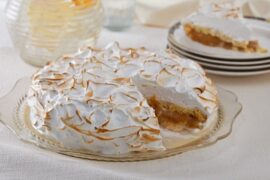
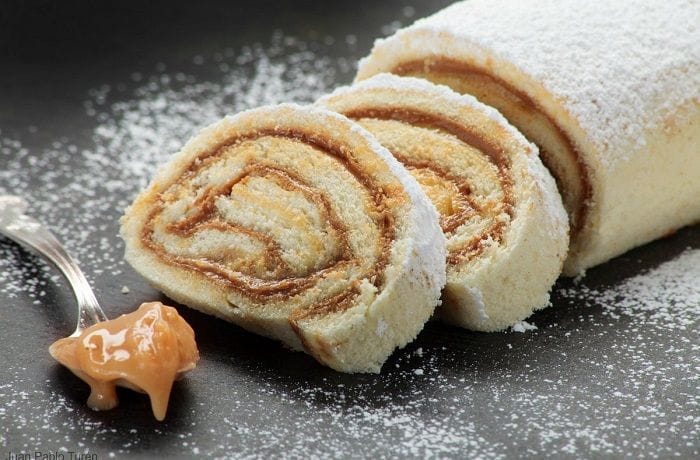
Chilean Brazo de Reina is a fluffy sponge cake rolled with manjar (dulce de leche) and sliced to serve — ready in just 50 minutes. One of the most beloved desserts across Chile for any occasion, each serving provides around 400 calories and a deeply satisfying combination of light cake and creamy caramel filling.
How to Make Brazo de Reina?
Brazo de Reina is essentially a thin and fluffy sponge cake filled with manjar and rolled into a log shape. The key technique is folding the meringue into the yolk mixture gently, which preserves the air incorporated during beating and gives the cake its characteristic lightness. Rolling while still warm is equally critical — a cold sponge cracks.
Nutritional Information
Each serving of Chilean Brazo de Reina contains approximately 400 calories, 65 g of carbohydrates, 8 g of fats, 7 g of protein, 1 g of fiber, 45 g of sugars, and 80 mg of sodium.
Chilean Homemade Brazo de Reina Recipe
Preparation: 30 minutes
Cooking: 20 minutes
Servings: 6 people
Ingredients
- 800 g of manjar (caramel spread)
- 200 g of flour without baking powder
- 200 g of powdered sugar
- 5 eggs
- A pinch of salt

Instructions
- Separate the egg yolks from the whites and in a large bowl, beat the yolks and half of the powdered sugar until they are integrated, begin to expand, and acquire a white color. Set aside.
- In a second bowl, beat the egg whites with a pinch of salt, gradually adding the remaining powdered sugar, until a meringue forms.
- Add the meringue to the beaten yolks, mix slowly with a silicone spatula in circular and enveloping movements, and add the flour in small portions until the mixture is complete.
- Turn on and preheat the oven to 160°C (320°F) for at least 10 minutes.
- Cover a baking tray with parchment paper and carefully spread the mixture, distributing it evenly until it reaches approximately 1 centimeter in thickness.
- Place the tray in the oven and bake for 8 to 10 minutes or until it is lightly golden. Remove and let cool until warm.
- Spread the manjar over the sponge cake and gently roll it up, pushing the dough with the parchment paper as it releases.
- Cool and serve the Brazo de Reina in slices, optionally covering with sifted powdered sugar, grated coconut, or chocolate sauce.
Additional Tips
Use eggs at room temperature — cold whites don’t whip to full volume
Remove the eggs from the refrigerator at least 30 minutes before starting. Cold egg whites whip to a lower volume than room-temperature whites, resulting in a denser sponge that is more likely to crack during rolling. If you forgot to temper them, place the whole eggs in a bowl of warm water for 5 minutes before separating.
Roll the sponge cake while still warm — a cold sponge will crack
As soon as the cake comes out of the oven and has cooled for about 5 minutes, roll it up with the parchment paper — without the filling — and let it set in that shape for 10 minutes. This trains the cake to hold the rolled form. When you unroll it to apply the manjar, it will open without resistance and re-roll cleanly without cracking.
Spread the manjar in an even, thin layer — too much filling causes collapse
Apply the manjar in a layer no thicker than 3 to 4 mm, leaving a 2 cm margin at the far edge so it doesn’t overflow when rolled. A thick filling adds too much weight and breaks the sponge structure. If the manjar is very stiff, warm it briefly in a bain-marie until spreadable.
| Ingredient | Substitution and result |
|---|---|
| Manjar (dulce de leche) | Strawberry or raspberry jam — lighter, fruitier version; reduce to a thin layer |
| Flour without baking powder | Cornstarch (maicena) — produces a more delicate, lighter sponge texture |
| Powdered sugar topping | Grated coconut or chocolate sauce — adds texture contrast to the surface |
| 5 eggs | No direct substitute — eggs are structural; do not reduce quantity |
Frequently Asked Questions (FAQs)
1. Why does my Brazo de Reina crack when I roll it?
Two reasons: the sponge was overbaked (dry and brittle) or it was too cold when you rolled it. Bake for 8 to 10 minutes only — the surface should spring back when lightly pressed. Roll it while still warm, using the parchment paper as a guide. If cracks appear, cover them with powdered sugar or a chocolate drizzle — it becomes a presentation choice, not a failure.
2. Can I use store-bought dulce de leche?
Yes. Chilean manjar and Argentine dulce de leche are functionally identical — use whichever is available. If the consistency is very liquid, refrigerate the jar for 30 minutes before spreading. Avoid caramel sauces designed for drizzling, as they are too runny and will soak into the sponge rather than hold their shape in the roll.
3. How long does Brazo de Reina keep?
Up to 3 days in the refrigerator, wrapped tightly in plastic wrap to prevent the sponge from drying out. The manjar filling acts as a moisture barrier, so the interior stays softer than the exterior. Do not freeze — the sponge loses its texture when thawed and becomes gummy.
4. Can I add fruit to the filling?
Yes — sliced strawberries, raspberries, or banana are the most common additions. Layer the fruit on top of the manjar before rolling. Avoid very juicy fruits like watermelon or citrus segments, which release liquid during refrigeration and make the sponge soggy within a few hours.
What Is Chilean Brazo de Reina?
Brazo de Reina — Queen’s Arm — is a Chilean rolled sponge cake filled with manjar (dulce de leche). It is the Chilean adaptation of the European “Brazo Gitano” (Gypsy’s Arm), distinguished by the absence of the original meringue coating and the use of manjar as the primary filling. The name “de Reina” (of the Queen) reflects the dessert’s historical association with elite households and convent pastry traditions. Today it is found in bakeries, cafés, and home kitchens across Chile for birthdays, afternoon tea, and everyday celebrations.
History of Brazo de Reina in Chile
The rolled sponge cake arrived in Chile through Spanish colonial influence, where it was known as Brazo de Gitano. The transformation into Brazo de Reina is tied to the pastry tradition that developed in Chilean convents from the 17th century onward. Nuns in these convents mastered the production of traditional Chilean sweets — alfajores, quince jelly, and manjar blanco — and it was in this context that the European rolled cake was adapted to local ingredients and tastes. The Spanish meringue coating was replaced by the more readily available manjar, and the name shifted from Gitano to Reina, reflecting the refined social context in which it was served. By the 20th century, the Brazo de Reina had become a staple of Chilean pastry culture, accessible to all social classes and sold in every bakery in the country.
Did You Know?
Brazo de Reina is also very popular in countries such as Argentina, Peru, Ecuador, and Colombia, where it is called “rollo,” “arrollado,” “tronco,” “brazo gitano,” or “pionono” — each country has adopted and renamed this rolled sponge cake according to its own culinary tradition.