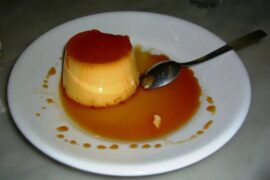
Chilean baked milk (leche asada) is a five-ingredient baked custard — 1 liter whole milk, 6 eggs, 500 g sugar, vanilla, and cinnamon — baked directly without a water bath for 45 minutes until it sets with a naturally toasted golden skin on top. Each serving provides approximately 500 calories.
A dessert closely associated with Chilean grandmothers’ kitchens, leche asada is one of the most economical and reproduced traditional sweets in Chilean home cooking.
How to Make Grandmother’s Baked Milk?
The process is similar to making a milk flan but with one key difference: leche asada is baked directly in the oven without a water bath (bain-marie). This produces a coarser, denser custard texture than flan — firmer throughout — and a thin toasted skin on the surface that is one of the dessert’s defining characteristics. The caramel is made in the same baking mold before the custard is poured in, so the dish unmolds with its sauce already built in.
Nutritional Information
Each serving of Chilean leche asada contains approximately 500 calories, 90 g of carbohydrates, 9 g of fats, 11 g of proteins, 0 g of fiber, 85 g of sugars, and 100 mg of sodium.
Homemade Baked Milk Recipe
Prep Time: 30 minutes
Cook Time: 45 minutes
Servings: 6
Ingredients
- 1 liter whole milk
- 500 g sugar (200 g for the caramel + 300 g for the custard)
- 6 eggs
- 1 teaspoon (5 ml) vanilla essence
- 1 cinnamon stick
Instructions
- Preheat the oven to 180°C (356°F) for at least 10 to 15 minutes.
- In an oven-safe baking mold, combine 200 g of sugar with 100 ml of water and stir until dissolved. Place in the preheated oven until the mixture caramelizes and turns a golden honey color. Remove from the oven, tilt the mold to coat the base and sides with caramel, and set aside to cool.
- In a medium bowl, whisk the eggs with 300 g of sugar for 1 minute until well combined. Add the milk, vanilla essence, and cinnamon stick. Stir until the mixture is uniform.
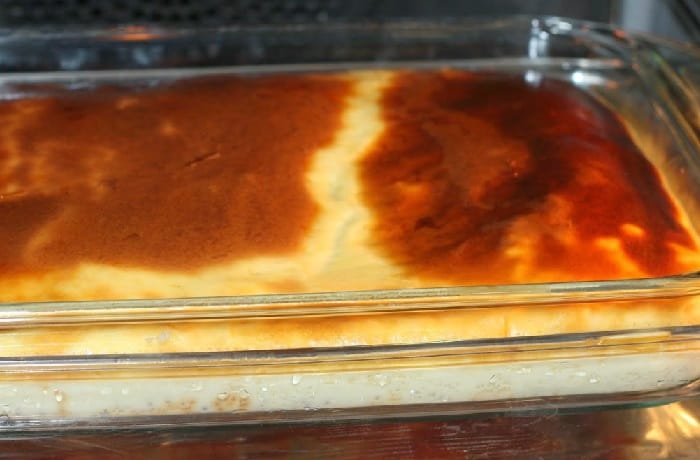
- Carefully pour the custard mixture over the caramelized mold. Bake in the preheated oven for 45 minutes, until the surface is golden and the custard is set — it should jiggle slightly at the center when moved but not be liquid.
- Remove from the oven and allow to cool to room temperature. Refrigerate for at least 2 hours before unmolding. To unmold, run a thin knife around the edges, place a serving plate face-down on the mold, and invert in one firm motion.
- Serve cold, cut into slices, bathed in the caramel that has collected in the mold. Optionally accompany with a spoonful of manjar (Chilean dulce de leche).
Additional Tips
Use whole milk — the fat content determines the texture
Whole milk produces a firm, creamy custard that holds its shape cleanly when unmolded. Semi-skimmed or skimmed milk reduces the fat that binds the custard proteins, resulting in a softer set that may collapse or crack when inverted. If you want to use lower-fat milk, bake the leche asada in individual ramekins rather than a single large mold — smaller portions are less likely to break when unmolded. Evaporated milk is an acceptable alternative: it is richer than whole milk and produces a particularly dense, creamy texture.
Watch the caramel closely — it goes from golden to burnt in seconds
The caramel stage in the oven (or stovetop alternative) is the most time-sensitive step. The sugar syrup transitions from pale gold to the correct amber color in under a minute, and continues to darken from residual heat even after removal from the oven. Pull it out as soon as it reaches a deep golden-amber color — too pale means a weak, thin caramel with no bitterness; too dark means a burnt, bitter sauce that overpowers the custard. Work quickly to tilt and coat the mold before the caramel hardens.
Refrigerate for at least 2 hours before unmolding
The custard needs full refrigeration to firm up enough to hold its shape when inverted. Attempting to unmold while still warm or after only 30 minutes of refrigeration almost always results in the custard breaking in the center. Two hours is the minimum; overnight refrigeration produces the best result and makes the caramel sauce more fluid and easy to pour. Run a thin-bladed knife around the full perimeter before inverting — this breaks the vacuum seal that forms between the custard and the mold walls.
| Ingredient | Substitution and result |
|---|---|
| Whole milk | Evaporated milk — richer and more concentrated; produces a denser custard; reduce sugar by 50 g |
| White sugar (caramel) | Piloncillo or coconut sugar — darker caramel with more complex, molasses-like flavor |
| Vanilla essence | Vanilla bean (split and scraped) or almond extract — vanilla bean gives a more pronounced aroma; almond adds a distinct nutty note |
| Cinnamon stick | Cardamom pod or star anise — different aromatic profile; both work as warm spice notes in the custard |
Baked Milk in a Thermomix
- Place the cinnamon stick in the Thermomix bowl and pulverize at speed 10 for 10 seconds. Add the sugar and process for another 15 seconds.
- Add the milk and vanilla essence. Mix at speed 4 for 30 seconds. Add the eggs and mix for another 30 seconds until fully combined.
- Prepare the caramel in the oven-safe mold as described in step 2 above. Pour the Thermomix custard mixture over the caramel and bake at 180°C for 45 to 50 minutes, until set and golden on top. Cool and refrigerate before unmolding.
Frequently Asked Questions (FAQs)
1. What is the difference between leche asada and flan?
The ingredients are nearly identical — milk, eggs, sugar, and vanilla — but the baking method is different. Flan is baked in a water bath (bain-marie), where the surrounding hot water creates gentle, even heat and produces a very smooth, silky custard. Leche asada is baked directly in the oven without a water bath, exposing the surface to direct heat. This produces a toasted golden skin on top, a firmer and slightly coarser texture throughout, and a denser final result. The name “leche asada” (roasted/baked milk) refers precisely to this direct baking method.
2. How do I know when the leche asada is fully baked?
The surface should be visibly golden, and the custard should jiggle only slightly at the very center when the mold is gently moved — like a soft gelatin. If the entire surface ripples when moved, it needs more time. Insert a thin knife or toothpick 2 cm from the edge: if it comes out clean, the outer custard is set. A completely still center is not required — residual heat and refrigeration will finish the set. Over-baking produces a rubbery texture with surface bubbling.
3. Can I make individual portions instead of one large mold?
Yes — individual ramekins (180 to 200 ml capacity) work well and are actually more forgiving for unmolding. Reduce the baking time to 25 to 30 minutes at 180°C and check for doneness at the 25-minute mark. Individual portions are also the recommended approach when using lower-fat milk, as smaller custards hold their shape better when inverted. Prepare the caramel directly in each ramekin on the stovetop or in the oven before pouring in the custard.
4. How long does leche asada keep in the refrigerator?
Up to 3 days, covered with plastic wrap or in an airtight container, still in its mold. Once unmolded, consume within 24 hours as the caramel begins to be absorbed into the custard and the surface texture changes. Do not freeze — the custard separates and weeps liquid when thawed.
What Is Chilean Leche Asada?
Leche asada (literally “roasted milk” or “baked milk”) is a traditional Chilean baked custard. Despite the name, no milk is “roasted” — the term describes the characteristic toasted skin that forms on the surface of the custard during direct oven baking. It sits within the broader Latin American family of milk custard desserts that includes flan, crème caramel, and crema catalana, but it is distinguished from all of them by the absence of a water bath and the resulting denser, browned-top character. It is one of the simplest and most widely reproduced traditional desserts in Chilean home cooking.
History of Leche Asada in Chile
Leche asada descends from the Spanish colonial tradition of milk custard desserts brought to Chile in the 16th century — specifically from Spanish flan and leche frita, themselves derived from the Roman and Moorish egg-and-milk custard traditions of medieval Iberia. The French crème brûlée and Catalan crema catalana share the same foundational technique and ingredients, reflecting the common European inheritance. The Chilean adaptation — direct baking without a water bath, producing the distinctive toasted surface — developed in the colonial kitchen as a practical simplification. The five basic ingredients (milk, eggs, sugar, vanilla, cinnamon) were among the most consistently available products in Chilean colonial and rural households, which is why the dessert became a fixture across all social classes. Today, leche asada is served in traditional Chilean restaurants alongside arroz con leche and mote con huesillos as one of the defining sweets of Chilean culinary identity.
Did you know?
A classic variation of leche asada uses thinly sliced apples arranged at the bottom of the mold, over which the caramel is poured before the custard is added. The apples soften and caramelize during baking, adding texture and a subtle fruit flavor to each slice. This variant is particularly common in central and southern Chile, where apple orchards are abundant, and is known informally as leche asada con manzana.