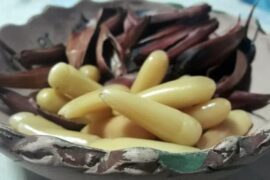
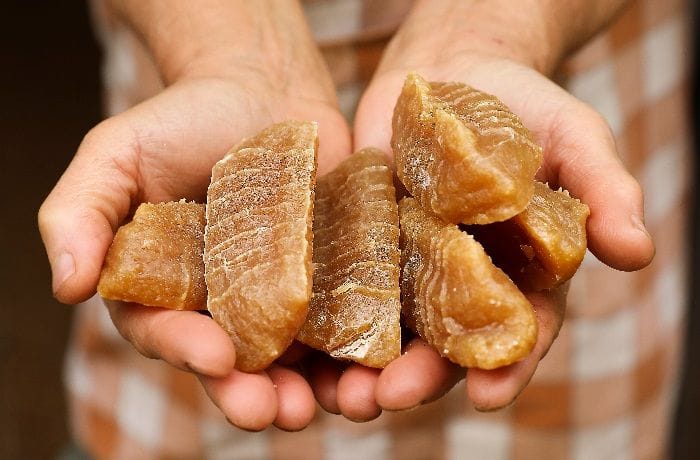
Chilean “Camotillos” are a very old sweet made in convents during the colonial period and have almost disappeared from the national recipe book. They are sugary on the outside and soft on the inside.
Nutrition Facts
Each serving of Chilean Camotillos (1 piece) contains approximately 180 kcal, 1 g of protein, 0 g of fat, 44 g of carbohydrates, 0 mg of cholesterol, and 15 mg of sodium.
How to Make Homemade “Camotillos”
“Camotillos” are sweets made from sweet potatoes and sugar that develop a hardened and darker crust on the outside, with a soft and moist golden center. The preparation still remains a completely artisanal process that can take several days.
Prep Time: 30 minutes
Cook Time: 60 minutes
Servings: 12
Ingredients
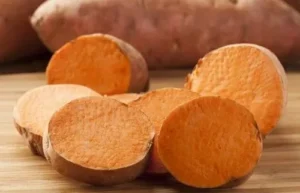
- 500 g firm sweet potatoes
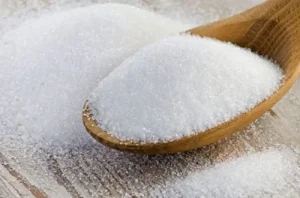
- 500 g granulated sugar
- 125 ml water
- 2 teaspoons orange zest
Instructions
- Turn on and preheat the oven to 180°C (356°F) for at least 10 minutes. Wash the sweet potatoes thoroughly, prick them with a fork, reserve a baking tray, and cook for 40 to 50 minutes until they are cooked, checking with the tip of a sharp knife, cool, peel, and mash with a fork or potato masher. Reduce the temperature to 150°C.
- In a medium saucepan, add the sugar and water, heat over medium heat, stir until dissolved, and add the sweet potato puree and orange zest. Integrate everything homogeneously and keep on low heat for about 20 minutes until the mixture thickens, and the bottom of the pan can be seen when scraped. Remove from heat and cool.
- Cover a flat baking tray with parchment paper, shape small oval masses with the puree using two spoons, and distribute carefully. Bake for 60 minutes until the surface is dry and crystallized. Traditionally, “Camotillos” are rested covered in a cool, dark place for one day in summer and two in winter and then transferred to a cabinet with enveloping heat for another 3 days.
Expert Cooking Tips
- Zest Infusion via Residual Heat: Add the orange zest at the same time as the puree. The heat allows the essential oils in the zest to emulsify with the natural starches of the sweet potato. This creates a more integrated flavor profile compared to adding it at the end.
- Low-Temperature Surface Dehydration: Bake at a reduced temperature of 150°C (302°F) for 60 minutes. This isn’t intended to “cook” the potato further but rather to induce the crystallization of the sugar on the surface. High heat would caramelize the sugar too quickly, making it bitter instead of creating a delicate crust.
- The Multi-Day Maturation Secret: Follow the traditional resting period of 1 to 2 days in a cool place followed by 3 days in “enveloping heat.” This slow dehydration allows the sugar molecules to align into a stable crystalline structure, while the center remains moist through hygroscopy, where the sugar holds onto the internal water.
Frequently Asked Questions (FAQ)
1. Why do Camotillos take so many days to make?
The process is artisanal and relies on slow dehydration to form the hard outer shell. Rushing this step results in a sticky candy that won’t have the characteristic “snap.”
2. Can I use any type of sweet potato?
While firm varieties are recommended, the dark red variety (yam style) with intense yellow pulp is ideal for a more vibrant color and richer flavor.
3. How do I store them once finished?
Store them in a dry, airtight container. Moisture is the enemy of the crystallized shell; if it’s too humid, the shell will dissolve.
4. Can I use a microwave to cook the potatoes?
It’s better to bake them. Baking concentrates the sugars through slow roasting, whereas microwaving can make the texture too watery for a proper puree.
5. Is the orange zest essential?
Yes, it provides the citrus backbone that balances the earthy sweetness of the tuber, making the candy taste refined rather than just sugary.
History of Chilean “Camotillos”
“Camotillos” are considered sweets that originated during the colonial era, made like other Chilean sweets traditionally in convents, as recorded by Oreste Plath in his book “Geographical Gastronomy of Chile.” The recipe was so popular in the early 20th century that even Marta Brunet, National Literature Prize winner in 1961, included them in her book “La Hermanita Hormiga,” her treatise on culinary art and recipes, first published in 1931.
Did You Know?
Sweet potatoes are tubers native to Central and South America, cultivated for over 5,000 years. They are currently produced in Chile in two varieties: one known as white sweet potato and another known as yam; the latter is characterized by its dark red skin, intense yellow pulp, and elongated-round shape.