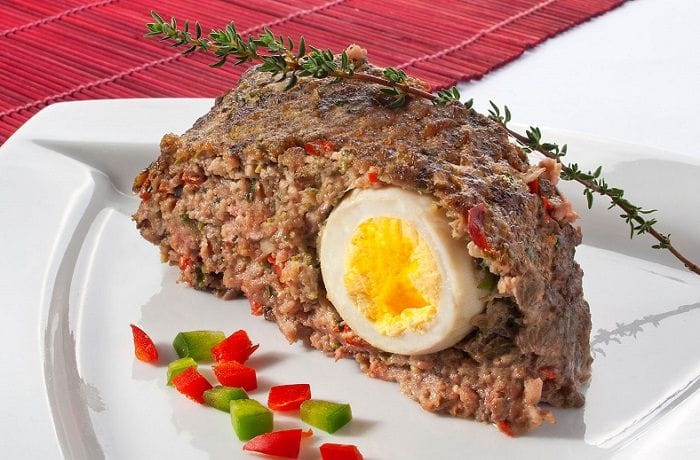
Chilean German-style roast (asado alemán) is a baked ground beef meatloaf layered with whole hard-boiled eggs — ready in 45 minutes. A rich traditional dish from southern Chile influenced by German immigration, each serving delivers around 350 calories and slices cleanly to reveal the egg cross-section that makes it as visually striking as it is satisfying.
How to Make Chilean German-Style Roast?
This is an extremely versatile dish and a very easy recipe to prepare. Ground meat is mixed with bread soaked in milk to achieve a moist, firm texture — the panade is the key to a meatloaf that holds together when sliced without becoming dense or dry. Parsley, onion, and carrot are added for flavor and moisture, and the mixture is layered around whole hard-boiled eggs before baking.
Nutritional Information
Each serving of Chilean German-style roast contains approximately 350 calories, 18 g of carbohydrates, 20 g of fats, 28 g of protein, 2 g of fiber, and 600 mg of sodium.
Homemade German-Style Roast Recipe
Preparation: 30 minutes
Cooking: 45 minutes
Servings: 6 people
Ingredients
- 600 g ground beef
- 100 ml milk
- 6 eggs
- 4 slices of bread or marraqueta
- 3 tablespoons parsley or cilantro
- 2 tablespoons Parmesan cheese
- 1 onion
- 1 carrot
- 1 tomato
- Complete seasoning (aliño completo)
- Bacon (optional)
- Salt
- Pepper
Instructions
- Place 4 eggs in a small pot with cold water, bring to a boil, and cook for 10 to 12 minutes. Cool, peel, and set aside.
- Place the slices of bread or marraqueta in a deep dish, pour warm milk over them to soak, then mash with a fork until you get a homogeneous mixture. Set aside.
- In a large bowl, mix the ground beef, soaked bread, finely chopped onion, grated carrot, finely chopped parsley, Parmesan cheese, 2 raw eggs, salt, pepper, and aliño completo to taste. Stir everything well until fully combined.
- Preheat the oven to 200°C (392°F) for about 10 minutes. Butter a rectangular mold or use a silicone mold. Optionally, slice the tomato and distribute over the base of the mold — this prevents the meat from sticking and adds moisture. Season the tomato with a little salt and oregano.
- Place a third of the meat mixture at the bottom of the mold, arrange the 4 hard-boiled eggs in a row along the middle line, cover the sides with meat, and then cover everything completely with the remaining mixture.
- Place the mold in the preheated oven and bake for 45 to 60 minutes or until well-cooked and golden on the surface. If excess liquid accumulates during baking, carefully drain it to avoid steaming the meat instead of roasting it.
- Cool for about 5 minutes before unmolding. Slice and serve hot, alone or accompanied by white rice or boiled potatoes.
Additional Tips
Drain excess liquid during cooking — steam ruins the crust
Ground beef releases water during baking, especially if the meat has high fat content or the bread-milk mixture was very wet. Check the mold at the 25-minute mark and carefully tilt it to drain any accumulated liquid. A wet environment inside the mold steams the meatloaf rather than roasting it, preventing the golden crust from forming on the surface and producing a pale, soft exterior instead of the traditional caramelized finish.
Let the meatloaf rest before unmolding — it slices cleanly when cooled
Immediately after removing from the oven, the proteins are fully contracted and the fat is still liquid — cutting at this moment produces crumbling and uneven slices. Allowing 5 to 10 minutes of rest lets the structure firm up and the juices redistribute. For an even cleaner cross-section that shows the egg clearly, refrigerate the entire unmolded roast for 30 minutes and slice cold with a sharp knife.
Use the tomato base — it prevents drying and adds a natural glaze
Sliced tomato distributed across the base of the mold serves two purposes: it creates a moisture barrier between the meat and the hot pan, preventing the bottom from drying out, and it releases juice during cooking that bastes the lower portion of the meatloaf naturally. The tomato also caramelizes slightly against the hot pan, producing a subtle sweetness on the exterior of the finished roast.
| Ingredient | Substitution and result |
|---|---|
| Ground beef | Ground pork or 50/50 beef and pork — juicier, slightly sweeter result |
| Bread soaked in milk | Panko breadcrumbs (½ cup) — firmer texture; still moist but less soft |
| Parmesan cheese | Gruyère or Gouda — meltier interior with a less sharp flavor |
| Ground beef (full recipe) | Hydrated soy protein — vegetarian version; same technique and seasoning |
Frequently Asked Questions (FAQs)
1. What makes Chilean German-style roast different from standard meatloaf?
The defining characteristic is the whole hard-boiled eggs layered inside, which create a dramatic cross-section when the roast is sliced. Standard meatloaf rarely includes whole eggs — the Chilean-German version inherited this technique from German Hackbraten (ground meat roast) tradition, where the egg insert is a signature element. The use of marraqueta bread (rather than breadcrumbs) in the panade is also distinctly Chilean, producing a moister, softer texture.
2. Can I prepare German-style roast in advance?
Yes — it actually slices more cleanly when prepared the day before. Bake completely, let cool, refrigerate overnight, then slice cold and reheat individual portions in a covered pan with a splash of water or broth, or in the oven at 160°C covered with foil for 15 minutes. The egg cross-section is also more visible and dramatic in cold slices than in hot ones.
3. Why do I put hard-boiled eggs inside the roast?
The eggs serve both a practical and a visual purpose. Practically, they add a protein-rich core with a different texture and flavor from the surrounding meat. Visually, when the roast is sliced, the eggs create a striking pattern across the cross-section — alternating circles of white and yellow egg within the dark meat — that has made this dish a showpiece in Chilean family cooking and a popular preparation for Sunday lunches and celebrations.
4. Can I make this recipe without an oven?
Yes — use a lidded skillet or dutch oven on the stovetop. Shape the meat mixture into a log around the hard-boiled eggs, place in a lightly oiled skillet, brown on all sides over medium heat (about 3 minutes per side), then add 100 ml of water or broth, cover, and cook over low heat for 35 to 40 minutes. The result will lack the golden surface crust of the baked version but will be fully cooked and flavorful.
What Is Chilean German-Style Roast?
Chilean German-style roast — asado alemán — is a baked ground beef meatloaf with whole hard-boiled eggs layered inside, a traditional dish from the German-influenced regions of southern Chile. It is known by different names depending on the country: pan de carne in Argentina, Hackbraten in Germany, polpettone in Italy, and pulpeta in Cuba — all variations of the same fundamental recipe, adapted to local ingredients and traditions. In Chile, the version with eggs inside and marraqueta bread in the panade is considered the definitive local expression of this preparation.
History of German-Style Roast in Chile
The German-style roast arrived in Chile with the wave of German immigration to the southern regions — particularly Valdivia, Osorno, Puerto Montt, and Llanquihue — that began in earnest from 1850 onward, when the Chilean government actively recruited German settlers to colonize the sparsely populated lake district. These immigrants brought their culinary traditions with them, including Hackbraten (ground meat roast), which was adapted to Chilean ingredients: the traditional rye bread was replaced with marraqueta, and local spices such as aliño completo were incorporated. Over the following generations, the dish became fully integrated into southern Chilean home cooking, losing its specifically German identity and becoming simply “asado alemán” — a Chilean dish with a German name. Today it is prepared throughout Chile, though it retains its strongest cultural association with the southern lake district cities where German culinary influence is most visible.
Did You Know?
In Argentina, it is simply known as “pan de carne” (meat bread); in Germany, they call it “hackbraten”; in the Middle East, it’s called “kebabs”; in Italy, “polpettone” (filled with ham and cheese); and in Cuba, “pulpeta.” Different names for the same basic recipe — ground meat, shaped and cooked in a mold — that appears independently across dozens of culinary cultures worldwide.