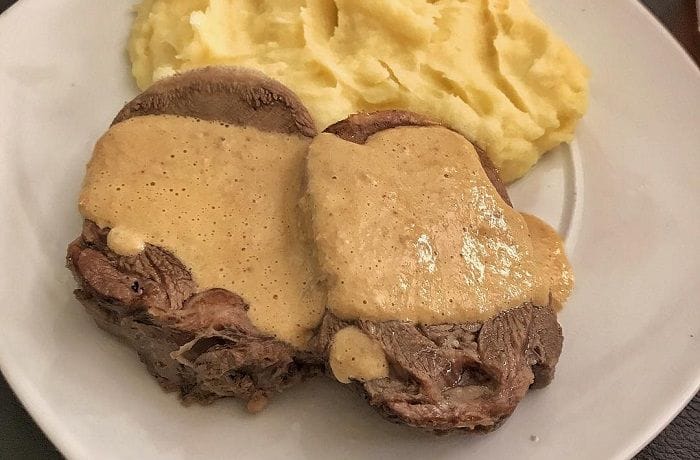
Chilean nogada beef tongue is a traditional Andean dish — whole beef tongue slow-cooked until tender in a pressure cooker, then sliced and simmered in a creamy walnut and milk sauce thickened with flour, ready in 90 minutes. A classic from the Chilean mountain and central valley regions, each serving delivers around 350 calories and the rich, nutty, subtly spiced flavor of the nogada sauce that makes this preparation one of the most distinctive and underappreciated dishes in Chilean cuisine.
How to Make Nogada Beef Tongue?
Beef tongue is a delicate and versatile cut that is often underappreciated but rewards proper preparation with a tender, succulent texture unlike any other cut. The pressure cooker is essential — it reduces the cooking time from the 3 to 4 hours required for stovetop braising to just 60 minutes. The walnut sauce (nogada) is built from the tongue’s own cooking broth combined with milk and blended walnuts, producing a sauce with both the richness of the broth and the creaminess of the nut base.
Nutritional Information
Each serving of Chilean nogada beef tongue contains approximately 350 calories, 18 g of carbohydrates, 22 g of fats, 32 g of protein, 2 g of fiber, and 700 mg of sodium.
Nogada Beef Tongue Recipe
Preparation: 30 minutes
Cooking: 80 minutes
Servings: 6 people
Ingredients
- 2 kg beef tongue
- 400 ml milk
- 200 g peeled walnuts
- 2 tablespoons flour or cornstarch
- 1 carrot
- 1 onion
- 1 bunch of assorted aromatics (celery, parsley, bay leaf)
- 1 green bell pepper
- 1 garlic clove
- Nutmeg zest
- Salt
- Pepper
Instructions
- Wash the beef tongue thoroughly under cold running water, drain on a clean cloth or paper towel, and set aside.
- In a pressure cooker, heat a little oil and add the bunch of aromatics, quartered onion, carrot, whole garlic, a piece of seedless bell pepper, and salt. Sauté together for 5 to 10 minutes until the aromatics are fragrant.
- Add the beef tongue to the pressure cooker, seal, and cook for about 60 minutes under pressure or until fully tender. Release pressure, allow to cool for a few minutes, then peel the outer skin from the tongue while still warm. Cut into strips of ½ cm thickness and set aside.
- In a large pot, add 2 cups of the strained cooking broth from the tongue, the milk, a grating of nutmeg, and the flour or cornstarch. Cook over medium heat, stirring constantly, for about 10 minutes until slightly thickened.
- Transfer the mixture to a blender, add the walnuts, and blend at medium speed until completely smooth and homogeneous.
- Return the blended nogada sauce to a pot, add the reserved tongue strips, and cook over low heat for another 10 minutes to heat through and allow the flavors to integrate.
- Serve the nogada beef tongue immediately, accompanied by white rice or mashed potatoes.
Additional Tips
Use a pressure cooker — it reduces cooking time from 3+ hours to 60 minutes
Beef tongue is a dense, heavily muscled organ that requires prolonged cooking to break down its connective tissue and become tender. Without a pressure cooker, the tongue must simmer in a covered pot for 3 to 4 hours over low heat. A pressure cooker achieves the same result in 60 minutes by raising the cooking temperature above the normal boiling point. If you do not have a pressure cooker, use a heavy-bottomed pot with a tight lid, add enough water to fully submerge the tongue, and simmer on the lowest setting for 3 hours, checking the water level every 45 minutes.
Peel the tongue immediately while still hot — cold tongue is difficult to skin
The outer skin of beef tongue (a tough membrane covering the entire organ) separates easily from the tender meat beneath when the tongue is hot and freshly cooked. If you allow the tongue to cool completely before peeling, the skin contracts and adheres firmly, making it much harder and more time-consuming to remove. As soon as you can handle the tongue safely (wearing kitchen gloves helps), start peeling from the base toward the tip — the skin should come off in large sections with gentle pulling. Any remaining small patches can be removed with a sharp knife.
Add aromatics to the initial cooking water — the broth becomes the sauce base
Celery, bay leaf, fresh parsley, and garlic added to the pressure cooker with the tongue infuse the cooking broth with herbaceous depth that carries into the nogada sauce. This aromatic broth is far more flavorful than plain tongue-cooking liquid and produces a more complex, rounded sauce. Strain the broth through a fine sieve before using it in the sauce to remove all solids — only the clear, flavored liquid should go into the sauce base.
| Ingredient | Substitution and result |
|---|---|
| Beef tongue | Lamb tongue (2–3 per serving) — milder, more tender; reduce pressure cooking to 35 minutes |
| Peeled walnuts | Blanched almonds — lighter color, slightly less bitter sauce; same blending technique |
| Flour (thickener) | Cornstarch (same quantity) — gluten-free; cleaner, glossier sauce texture |
| Whole milk | Single cream — richer, more velvety sauce; reduce by 20% for same consistency |
Frequently Asked Questions (FAQs)
1. What does nogada mean?
Nogada refers to a sauce made with walnuts — from “nogal,” the Spanish word for walnut tree (Juglans regia). In Chilean and broader Andean cooking, “en nogada” designates any preparation in which meat is served with a walnut-based white sauce, typically made from blended walnuts, milk, and cooking broth. The nogada sauce in Chile is similar in concept to the Mexican chiles en nogada sauce, though the two preparations are entirely independent and use different techniques. The walnut sauce tradition arrived in Chile from Spanish colonial cooking, where walnut sauces appeared in medieval Iberian cuisine.
2. Is beef tongue difficult to cook?
The technique is simple but time-sensitive — the primary challenges are the long cooking time and the peeling step. With a pressure cooker, the 60-minute cooking time is manageable. The peeling is straightforward if done while the tongue is hot. The rest of the preparation (making the nogada sauce) is no more complex than making a béchamel. The main risk in cooking beef tongue is under-cooking — an insufficiently cooked tongue will be tough and rubbery throughout; a properly cooked one will be silky and tender. Test by inserting a skewer: it should slide in and out without resistance.
3. What does beef tongue taste like?
Cooked beef tongue has a mild, clean beef flavor that is richer and more tender than most muscle cuts, with a smooth, uniform texture that almost dissolves on the palate. It does not taste “organ-y” or gamey when properly prepared — the flavor is essentially concentrated beef without the grain of muscle fiber. Many people who are initially reluctant to try tongue are surprised by how approachable and pleasant the flavor is. The nogada walnut sauce adds richness and a nutty sweetness that complements the mild beef flavor particularly well.
4. Can I serve nogada beef tongue cold?
Yes — cold sliced beef tongue with nogada sauce is an excellent appetizer or cold plate. The tongue must still be peeled and sliced while warm, then refrigerated. The nogada sauce thickens when cold into a spreadable consistency that works well as a dip or spread. For a cold serving, slice the tongue thinner (about 3 mm), arrange on a plate, and spoon the cold nogada sauce over it. Cold tongue with nogada is a traditional appetizer in Chilean Andean cooking and appears at celebrations and family gatherings.
What Is Chilean Nogada Beef Tongue?
Chilean nogada beef tongue — lengua nogada — is a traditional preparation from the Andean and central valley regions of Chile, in which whole beef tongue is pressure-cooked until tender, sliced, and served in a walnut sauce (nogada) made from blended walnuts, tongue broth, and milk. It is considered a classic of Chilean home cooking for special occasions — Sunday lunches, family celebrations, and holiday meals — and represents the broader tradition of offal cooking that was central to Chilean cuisine before the 20th-century shift toward muscle cuts as the preferred form of beef. Today, beef tongue with nogada sauce is experiencing a revival in Chilean restaurants that celebrate traditional and heritage cooking.
History of Nogada in Chile
Walnut-based sauces have ancient roots in Mediterranean cuisine — they appear in Roman cooking, in medieval Spanish and Italian culinary manuscripts, and in the Arabic culinary tradition that influenced Iberian cooking. The Spanish brought walnut sauce traditions to Latin America, where they merged with local ingredients to produce regional variations. In Chile, the nogada sauce tradition took hold in the central and Andean regions where walnut trees (nogales) were planted by Spanish colonizers and grew abundantly in the temperate climate of the Aconcagua, Cachapoal, and Colchagua valleys. Beef tongue with nogada became a celebration dish in Chilean homes — a preparation that demonstrated cooking skill and used a cut (tongue) that was inexpensive but required patience and technique to prepare well. The dish is particularly associated with the Chilean Andes towns and with the cooking of the central valley estates (haciendas) where both beef tongue and walnuts were readily available.
Did You Know?
Beef tongue is rich in vitamin B12, which helps promote a healthy nervous system, as well as zinc — an essential mineral for the healthy growth and function of immune system cells. Despite its reputation as an unusual cut, beef tongue is one of the most tender and nutritious parts of the animal, with a higher fat content than lean muscle cuts that contributes to its characteristic silky texture when slow-cooked. In Chilean cooking, it can be enjoyed boiled, in walnut sauce as in this recipe, fried, or in a sandwich with mayonnaise — making it one of the most versatile cuts in the traditional Chilean kitchen.
How to adapt this recipe to a vegan or vegetarian version?
How to adapt this recipe to a gluten-free version?
How to adapt this recipe to a keto (ketogenic) version?
Recommended
- Chilean papaya jam recipe
- Pink Panther Cocktail recipe
- Italian “as” sándwich recipe
- Chilean pickled onion recipe