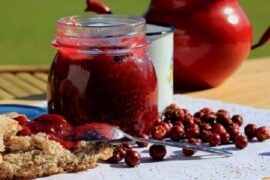
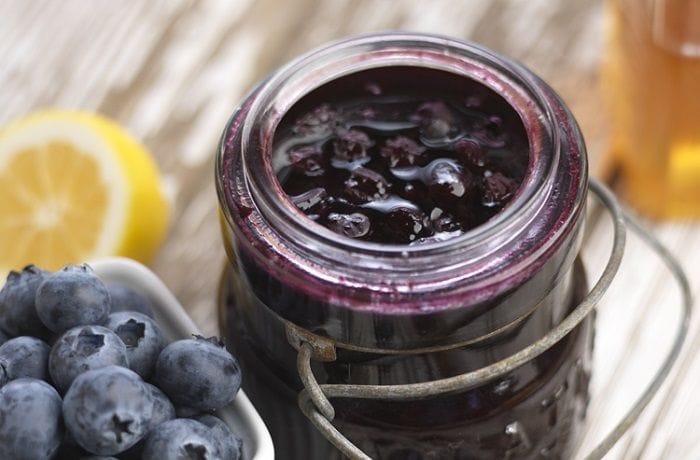
Chilean blueberry jam is a three-ingredient preserve — 1 kg of blueberries macerated with sugar for 3 hours to draw out their juice, then cooked for 40 minutes until set. No pectin needed. Each serving provides approximately 400 calories.
The result is a deep purple, spreadable jam with a concentrated blueberry flavor, ideal for toast, cheese boards, yogurt, or as a filling for pastries and cakes.
How to Make Blueberry Jam?
The blueberry’s moderate natural pectin content — concentrated mainly in the skin — is sufficient to set this jam without commercial pectin, provided the lemon juice is included. The lemon juice lowers the pH of the mixture, which activates pectin gel formation during cooking. The doneness test for jam without a thermometer: spoon a small amount onto a cold plate (pre-chilled in the refrigerator), allow it to cool for 30 seconds, then push it with your finger — if the surface wrinkles and the jam does not flow back together, it has reached the setting point and is ready.
Nutritional Information
Each serving of Chilean blueberry jam contains approximately 400 calories, 98 g of carbohydrates, 0 g of fats, 1 g of proteins, 3 g of fiber, 93 g of sugars, and 2 mg of sodium.
Homemade Blueberry Jam Recipe
Maceration: 3 hours
Prep Time: 30 minutes
Cook Time: 40 minutes
Servings: 6
Ingredients
- 1 kg blueberries
- 500 g white sugar
- 1 tablespoon lemon juice

Instructions
- Wash the blueberries in cold water, removing any stems, leaves, or damaged fruit without breaking the berries. Drain thoroughly and transfer to a large bowl.
- Pour the sugar over the blueberries and stir gently with a wooden spoon until the sugar is evenly distributed. Cover the bowl with plastic wrap and refrigerate for 3 hours. The sugar will draw moisture out of the berries, forming a natural syrup — this maceration step concentrates the flavor and helps the jam set.
- Transfer the macerated blueberries and all their accumulated syrup to a medium, heavy-bottomed pot (copper is traditional; stainless steel works equally well). Add the lemon juice and stir gently.
- Cook over medium-high heat, stirring frequently, until the mixture reaches a boil. Reduce to medium-low and continue cooking for 30 to 40 minutes, stirring every few minutes to prevent sticking, until the jam thickens to the desired consistency. Skim any foam that forms on the surface.
- Test for doneness using the cold plate method: spoon a small amount onto a pre-chilled plate, wait 30 seconds, then push with your finger — if the jam wrinkles and holds its shape, it is ready. If it flows back, cook for 5 more minutes and test again.
- While still hot, ladle the jam into clean, sterilized glass jars. Fill to within 5 mm of the rim, seal immediately, and invert for 5 minutes to create a vacuum seal. Store in a cool, dark place. Once opened, refrigerate and consume within 3 weeks.
Additional Tips
The 3-hour maceration is not optional — it extracts pectin and deepens flavor
The maceration step serves two purposes that cannot be replicated by simply adding water. First, the osmotic effect of the sugar pulls the natural juice and pectin compounds out of the blueberry skins, creating the syrup that the jam cooks in — this produces a more concentrated blueberry flavor than adding water would. Second, the blueberry juice that accumulates during maceration already has the sugar evenly dissolved in it, which means the cooking process is more uniform from the start and reduces the risk of the sugar crystallizing on the bottom of the pot before the fruit has broken down. Three hours is the minimum; overnight maceration (up to 12 hours, refrigerated) produces an even more intense result.
Sterilize your jars properly — the seal determines shelf life
Jars can be sterilized by boiling them (lids included) in water for 10 minutes, then draining upside down on a clean cloth without touching the interior. Alternatively, place washed jars (without lids) in the oven at 120°C for 15 minutes. Fill the jars while both the jam and the jars are hot — the temperature differential creates the vacuum seal that preserves the jam at room temperature for up to 12 months. A properly sealed jar will make a popping sound as it cools. Any jar that does not seal correctly (the lid does not pop or feels flexible) should be refrigerated and consumed first.
Skim foam during cooking to improve color and texture
As the blueberry jam cooks, a purple-blue foam forms on the surface — this is a mixture of air bubbles, fruit proteins, and impurities released by the berries during heating. Skimming it off periodically with a spoon produces a clearer, more vibrant jam with a cleaner finish. If you prefer not to stop stirring to skim, add half a teaspoon of cold butter to the pot at the end of cooking — the fat destabilizes the foam and causes it to dissipate within 30 seconds. This is a widely used trick in commercial jam production.
| Ingredient | Substitution and result |
|---|---|
| Blueberries | Blackberries (moras) or boysenberries — similar anthocyanin content and tartness; use same ratio; result is slightly more tart and darker |
| White sugar | Raw cane sugar (azúcar rubia) — slightly darker color and mild molasses note; same quantity |
| Lemon juice | Citric acid (ácido cítrico) — 1/4 teaspoon per kg of fruit dissolved in 2 tablespoons of water; cleaner acidity with no lemon flavor; available in pharmacies and food supply shops |
Frequently Asked Questions (FAQs)
1. Do I need to add pectin to blueberry jam?
No. Blueberries contain moderate levels of natural pectin, concentrated mainly in the skin, which is sufficient to set the jam without added commercial pectin — provided the lemon juice is included. The lemon juice is essential because it lowers the pH of the mixture, activating the pectin’s gel-forming properties during cooking. Without lemon juice, the jam may not set properly even with a long cooking time. If using very ripe or frozen blueberries (which have softer skins and lower pectin), add an extra half tablespoon of lemon juice as insurance.
2. How long does homemade blueberry jam last?
Properly sealed in sterilized jars, blueberry jam keeps for 10 to 12 months in a cool, dark pantry. Once opened, refrigerate and consume within 3 weeks. Signs of spoilage include visible mold (even a small spot — discard the entire jar), an off or fermented smell, or a very loose, syrupy texture that indicates the jam has separated. Jars with a flexible lid that was never vacuum-sealed should be refrigerated immediately and treated as refrigerator jam with a 3-week shelf life.
3. Why do I macerate the blueberries in sugar first?
The maceration step draws liquid out of the blueberries through osmosis, dissolving the sugar into the natural fruit juice. This eliminates the need to add water to start the cooking, which would dilute the flavor. It also distributes the sugar evenly into the fruit before heat is applied, preventing the sugar from burning on the pot bottom while the berries are still intact. The result is a more concentrated, fruit-forward jam with better color than one made by simply combining fruit, sugar, and water in a pot.
4. Why does the jam need lemon juice?
Lemon juice serves two functions: acidification and flavor balance. Pectin only forms a gel within a specific pH range (approximately 3.0 to 3.5) — blueberries are mildly acidic (around pH 3.5 to 4.0) but often not acidic enough on their own, especially if the fruit is very ripe. The lemon juice brings the mixture into the optimal pH range for gel formation. It also brightens the fruit flavor and counterbalances the sweetness of the sugar, preventing the finished jam from tasting flat or one-dimensionally sweet.
What Is Chilean Blueberry Jam?
Chilean blueberry jam (mermelada de arándanos) is a fruit preserve made from fresh blueberries cooked with sugar and lemon juice until the mixture gels. Unlike pectin-added commercial jams, this homemade version relies on the natural pectin in the blueberry skins and the acidity of the lemon juice to achieve its set — producing a jam with a more complex, fruit-forward flavor and a softer, slightly more rustic texture than factory products. Blueberries are one of the richest food sources of anthocyanins — the pigments responsible for their deep purple color — which have been shown to reduce oxidative stress, lower blood pressure, and decrease the risk of cardiovascular disease. The fruit is also high in dietary fiber (3.6 g per 150 g cup, covering 12 to 14% of the recommended daily intake), supporting digestive health and slowing glucose absorption.
History of Blueberry Jam in Chile
Jam-making as a preservation technique arrived in Chile with European colonial settlers in the 16th and 17th centuries, adapted from Spanish and Moorish fruit-preservation traditions. For most of Chilean culinary history, the standard homemade jams were made from quince (dulce de membrillo), peaches (melocotón), and strawberries — fruits that had been cultivated in the country since the colonial period. The cultivated highbush blueberry (Vaccinium corymbosum) is not native to Chile — it was introduced from North America as an agricultural export crop in the 1970s and 1980s. Within two decades, Chile became one of the top five blueberry exporters in the world, with production concentrated in the Bio-Bío, La Araucanía, and Los Lagos regions. As the industry scaled, domestic availability increased dramatically and prices fell, making blueberries accessible to Chilean households during the summer harvest season (December to March). Homemade blueberry jam became widespread in Chilean kitchens from the 1990s onwards, gradually joining — and in many households replacing — the traditional quince and peach jams as the season’s primary homemade preserve.

Did you know?
Chile produces approximately 100,000 to 130,000 tonnes of blueberries annually, the vast majority exported to the United States, Europe, and Asia. However, during the December-to-March harvest season, fresh blueberries are available at very low prices in Chilean markets and roadside stalls, particularly in the south-central regions where production is concentrated. This seasonal abundance is what makes homemade blueberry jam economically practical for Chilean households — at peak season, 1 kg of blueberries can cost a fraction of its off-season price, making this recipe one of the most cost-effective jams to produce at home.