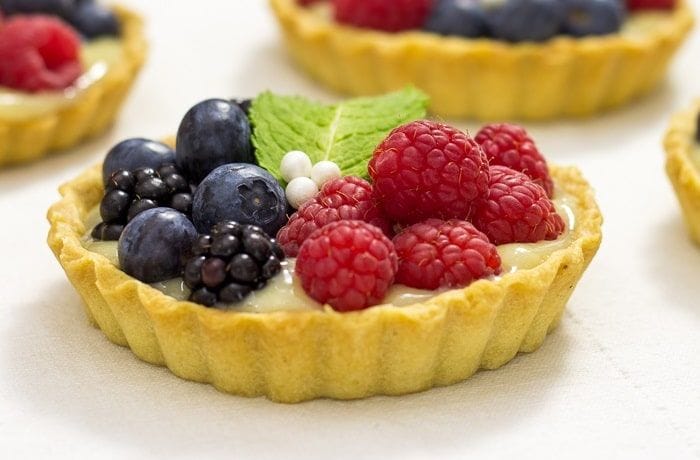
Chilean fruit tartlets are a classic summer dessert — buttery shortcrust pastry shells filled with vanilla pastry cream and topped with an arrangement of fresh seasonal fruits, ready in 80 minutes. Each serving delivers around 350 calories and the combination of crispy pastry, silky cream, and the natural sweetness of fresh fruit that makes this preparation one of the most popular desserts for summer celebrations and afternoon tea across Chile.
How to Make Fruit Tartlets?
This recipe is entirely possible to make at home — the shortcrust dough is simple and forgiving, and the pastry cream can be prepared well in advance. The critical technique is freezing the tart shells before baking to prevent shrinkage, and cooling the pastry cream completely before filling so it does not soften the pastry base. Use the freshest seasonal fruits available for the topping.
Nutritional Information
Each serving of Chilean fruit tartlet contains approximately 350 calories, 55 g of carbohydrates, 12 g of fats, 6 g of protein, 2 g of fiber, 30 g of sugars, and 120 mg of sodium.
Chilean Fruit Tartlet Recipe
Preparation: 60 minutes
Cooking: 20 minutes
Servings: 6 people
Ingredients
1. Dough
- 350 g of flour
- 200 g of butter
- 120 g of icing sugar
- 1 egg yolk
- 1 to 2 tablespoons of ice water
2. Pastry Cream
- 500 ml of whole milk
- 100 g of sugar
- 4 egg yolks
- 2 tablespoons of cornstarch
- 1 teaspoon of vanilla essence
3. Fruit Topping
- Raspberries
- Strawberries
- Kiwis
- Blueberries
- Blackberries
- Grapes
- Cherries
- Peaches
Instructions
1. Dough
- In a large bowl, add the sifted flour, icing sugar, and cubed cold butter. Mix with your fingers until achieving a crumbly, sandy texture. Incorporate the egg yolk and ice water, and work with your hands just until the dough comes together into a uniform ball — do not overwork.
- Divide the dough and press it with your fingers into individual tartlet molds (or two 20 cm diameter molds), about 3 to 5 mm thick. Prick the base all over with a fork, cover with plastic wrap, and freeze for at least 30 minutes.
2. Pastry cream
- In a medium bowl, sift the cornstarch, add the egg yolks and sugar, and beat with a whisk until smooth and pale.
- In a medium pot, heat the milk without boiling, add the vanilla essence, and gradually pour into the yolk mixture while continuously whisking. Return everything to the pot and cook over medium-low heat, stirring constantly, until the cream thickens and begins to bubble. Remove from heat immediately.
- Transfer to a bowl set over another bowl of ice water (inverted bain-marie) and stir occasionally until the pastry cream cools completely to room temperature. Cover with plastic film directly on the surface to prevent a skin from forming. Refrigerate until needed.
3. Assembling the tartlets
- Preheat the oven to 180°C (356°F). Remove the frozen tart shells and bake for 20 to 25 minutes until lightly golden at the edges. Remove, cool completely, and unmold.
- Fill each cooled tart shell with cold pastry cream, spread with a small spatula, and arrange the fresh fruits decoratively on the surface. Serve immediately and keep refrigerated.
Additional Tips
Freeze the tart shells for at least 30 minutes before baking — prevents shrinkage
Shortcrust pastry contains a high proportion of butter. When cold butter hits a hot oven, it melts before the gluten network has had time to set, causing the pastry to shrink and slide down the sides of the mold. Freezing the lined shells for at least 30 minutes (or refrigerating for 2 hours) firms the butter so the shell holds its shape while the oven heat sets the dough structure. This single step is the most common technique for avoiding shrunken, distorted tart shells.
Cool the pastry cream completely before filling — warm cream softens the shell
Hot or warm pastry cream releases steam and moisture that is absorbed by the baked tart shell within minutes, turning the crisp pastry base soggy. Cool the cream completely in an ice-water bath after cooking, then refrigerate until cold before filling the shells. The filling should be cold and set, not pourable — it should hold its shape when spooned into the shell and spread with a spatula without running into the pastry.
Add the fruit topping just before serving — moisture softens the cream surface after 2 hours
Fresh fruit releases juice as it sits on the cream surface. Berries and stone fruits can make the cream surface watery and unappealing within 2 to 3 hours. Assemble the tartlets just before serving if possible, or at most 2 hours ahead and refrigerate. For a professional finish that holds longer, brush the fruit lightly with warmed neutral apricot glaze — this creates a moisture barrier and gives the fruit a glossy appearance.
| Ingredient | Substitution and result |
|---|---|
| Icing sugar (in dough) | Granulated sugar — slightly coarser texture in the dough; similar baked result |
| Cornstarch (in cream) | Plain flour (2½ tablespoons) — slightly heavier, less glossy cream; works adequately |
| 4 egg yolks (in cream) | 2 whole eggs — lighter yellow color, less rich result; adequate substitute |
| Vanilla essence | Vanilla bean paste — more complex, more aromatic flavor with visible seeds |
Frequently Asked Questions (FAQs)
1. What is the difference between a tart and a tartlet?
A tart is a large open-faced pastry shell (typically 20 to 28 cm in diameter) filled with cream, custard, fruit, or other filling, then sliced into portions for serving. A tartlet is an individual-sized version (typically 8 to 12 cm in diameter) meant to be served as a single portion without slicing. The technique and recipe are identical — the only difference is the mold size and the serving format. Tartlets have an advantage in professional presentation because each serving has its own intact pastry edge.
2. How do I prevent the tart shell from shrinking during baking?
Three techniques work together: (1) Use cold butter and handle the dough minimally to avoid developing gluten. (2) Once the dough is pressed into the mold, freeze for at least 30 minutes before baking — this firms the butter and sets the shape. (3) Prick the base thoroughly with a fork before freezing to allow steam to escape during baking, which prevents bubbling and distortion of the base.
3. Can I prepare the components in advance?
Yes — and it is actually better to do so. The pastry dough can be made up to 3 days ahead and refrigerated, or frozen for up to 1 month. The baked tart shells keep well in an airtight container for 2 days. The pastry cream keeps refrigerated for up to 3 days. Assemble the tartlets with cream and fruit the day of serving — combining the components too early (more than 3 to 4 hours) makes the pastry soggy.
4. What is Tarte Tatin and how is it different from fruit tartlets?
Tarte Tatin is an upside-down French caramelized apple tart, first made at the Hôtel Tatin in Lamotte-Beuvron at the end of the 19th century — the fruit is caramelized in butter and sugar in the pan, the pastry is placed on top, the tart is baked, then inverted to serve. Fruit tartlets are a completely different preparation: the pastry shell is baked blind (without filling), cooled, then filled with cold pastry cream and raw fresh fruit. The two share only the use of pastry and fruit — the technique, temperature, and result are entirely different.
What Is Chilean Fruit Tartlet?
Chilean fruit tartlet — tartaleta de frutas — is an individual pastry dessert composed of a baked shortcrust shell filled with vanilla pastry cream and topped with fresh seasonal fruits. It is a staple of Chilean pastry shops (pastelerías), bakeries, and home kitchens during the summer months, when Chilean fruits — strawberries, raspberries, blueberries, peaches, and cherries — are at their peak. The tartlet is prized for its versatility: the same base recipe accommodates any fruit, and the components can be prepared days in advance and assembled at the last minute.
History of Fruit Tartlets in Chile
The fruit tart is a product of the French pastry tradition that spread across Europe and Latin America during the 19th and early 20th centuries. French pastry techniques were brought to Chile by European immigration — particularly from France and Germany — and by Chilean cooks and confectioners trained in the European tradition. The Chilean pastelería (pastry shop) became one of the cultural institutions of urban Chilean life by the early 20th century, and the fruit tart and tartlet were quickly adopted as summer signature preparations, adapted to local seasonal fruits rather than the apples and pears of the French original. The modern Chilean fruit tartlet draws on the same pastry cream and shortcrust technique as the French tarte aux fruits, but with a distinctly Chilean fruit palette during the November to March summer season. The Tarte Tatin, the famous upside-down apple tart born at La Maison Tatin in Lamotte-Beuvron at the end of the 19th century, is considered the inspiration point for the wider tradition of fruit tart innovation in Chile.
Did You Know?
The fruit tartlet as we know it today is a recipe inspired by the Tarte Tatin — a traditional dessert of French pastry that was born in the kitchen of La Maison Tatin located in Lamotte-Beuvron at the end of the 19th century. Unlike the modern fruit tartlet with its cold pastry cream and fresh fruit topping, the original Tarte Tatin was a hot baked caramelized apple tart served inverted — a completely different preparation that nonetheless sparked the broader French fruit pastry tradition that influenced Chilean pastry culture.