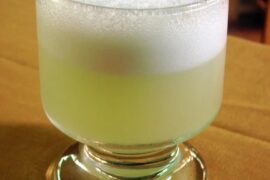

Chilean Roman Punch is a three-ingredient cocktail — white wine, champagne, and pineapple ice cream — combined in 10 minutes and served ice-cold. One of the most traditional drinks for Christmas and New Year’s celebrations in Chile, each serving delivers around 500 calories with a refreshing balance of acidity, bubbles, and tropical sweetness.
How to Make Chilean Roman Punch?
Roman punch is a very refreshing cocktail and easy to prepare. The key is to use partially thawed — not fully melted — pineapple ice cream, which gives the drink its characteristic thick, frothy texture. Believed to have inspired the creation of the popular Chilean earthquake (terremoto) cocktail, Roman punch is the more refined, festive version served at Christmas and New Year’s tables.
Nutritional Information
Each serving of Chilean Roman Punch contains approximately 500 calories, 45 g of carbohydrates, 5 g of fats, 3 g of protein, 1 g of fiber, 40 g of sugars, and 20 mg of sodium.
Chilean Roman Punch Recipe
Preparation: 10 minutes
Servings: 6 people
Ingredients
- 750 ml white wine
- 750 ml champagne (sparkling wine)
- 1 liter pineapple ice cream
Instructions
- Thaw the pineapple ice cream until it reaches a creamy consistency without becoming completely liquid.
- In a large bowl, pour the bottles of white wine and champagne in a 1-to-1 combination or adjust to your taste.
- Add the thawed pineapple ice cream, mix gently, and refrigerate for about two hours.
- Serve the Roman punch well chilled in a champagne or martini glass, optionally adding an additional scoop of pineapple ice cream.
Additional Tips
Thaw the ice cream to a creamy consistency — not fully melted
Remove the pineapple ice cream from the freezer 20 to 30 minutes before mixing. It should be soft and scoopable but still holding its shape. Fully melted ice cream produces a watery punch that separates quickly; ice cream that is still too frozen creates lumps that don’t incorporate into the wine. The right consistency resembles thick soft-serve.
Use a semi-dry or brut sparkling wine — sweetness balance is key
Avoid extra-brut (too austere) or demi-sec (too sweet) sparkling wines. A standard brut or semi-dry cava, prosecco, or Chilean espumante works perfectly. The pineapple ice cream provides significant sweetness on its own — a sweet sparkling wine will make the punch cloying. The white wine component can be a dry Sauvignon Blanc or Chardonnay.
Serve immediately after mixing — carbonation dissipates quickly
Once the champagne is added, the punch begins losing its bubbles. Mix gently to preserve carbonation (vigorous stirring collapses the bubbles) and serve within 30 minutes. If preparing for a large group, add the champagne in small batches as you serve rather than all at once.
| Ingredient | Substitution and result |
|---|---|
| Pineapple ice cream | Mango or passion fruit sorbet — same technique; more tropical and lighter result |
| Champagne | Cava or Prosecco — identical technique at a lower cost; slightly less complex |
| White wine | Moscato d’Asti — sweeter result; reduce ice cream quantity to compensate |
| Whole serving | Non-alcoholic version: sparkling grape juice + pineapple sorbet |
Frequently Asked Questions (FAQs)
1. What type of sparkling wine is best for Roman Punch?
A brut or semi-dry sparkling wine works best — cava, prosecco, or Chilean espumante are all excellent choices. Avoid very sweet sparkling wines (demi-sec or doux) as the pineapple ice cream already provides substantial sweetness. Genuine Champagne works perfectly but is not necessary given the other strong flavors in the drink.
2. Can I make Roman Punch in advance?
Partially. You can mix the white wine and ice cream up to 2 hours ahead and refrigerate. Add the sparkling wine only at the moment of serving — it will lose its carbonation if added too early. The ice cream component also continues to melt during refrigeration, so adding the champagne at the last minute preserves the best texture and effervescence.
3. Is Roman Punch very alcoholic?
Yes — it contains both white wine and champagne, each typically 11 to 12% alcohol. A standard serving (approximately 250 ml) delivers roughly 2 to 2.5 standard drink units. The sweetness of the pineapple ice cream masks the alcohol, making it easy to consume more than intended. For a non-alcoholic version, substitute both wines with sparkling grape juice.
4. What is the difference between Roman Punch and Chilean Terremoto?
Both are ice cream and wine cocktails, but they differ in key ingredients and context. Terremoto uses pipeño (sweet young wine) and pineapple ice cream, is served in a tall glass, and is the classic Independence Day (Fiestas Patrias) drink. Roman Punch uses white wine and champagne, is served in a champagne or martini glass, and is associated with Christmas and New Year’s. Roman Punch is believed to have directly inspired the creation of Terremoto.
What Is Chilean Roman Punch?
Roman Punch — Ponche a la Romana in Spanish — is a traditional Chilean festive cocktail made by combining white wine, champagne, and pineapple ice cream. Unlike most cocktails, it is as much a dessert as a drink — thick, sweet, and served in elegant glassware. It has been a fixture of Chilean Christmas and New Year’s celebrations for generations and is considered one of the country’s most distinctive holiday beverages.
History of Roman Punch in Chile
The original Roman punch was a preparation associated with the Vatican’s papal court, originally made with white wine and meringue. It later evolved across European aristocratic circles to include champagne and sorbet, becoming a staple of 19th-century high society entertaining. According to tradition, Napoleon’s capture of one of the Pope’s personal cooks — who later served Josephine — helped spread the recipe across France and eventually Europe. The punch arrived in Chile through Spanish and French culinary influence during the colonial and post-independence period, where it was adopted by affluent households as a Christmas celebration drink. Over the 20th century it became widely democratized, and today it appears at Christmas tables across all social classes. Chilean food historians also credit Roman Punch as the direct precursor to the Terremoto, Chile’s most famous Independence Day cocktail, which replaces the champagne with pipeño and is served in a much larger format.
Did You Know?
Legend has it that Roman punch was once a closely guarded secret recipe. When Napoleon took one of the Pope’s cooks prisoner and appointed him head chef to Josephine, the punch allegedly began to be prepared in France — and from there spread across the world to eventually become a Chilean Christmas tradition.
How to adapt this recipe to a vegan or vegetarian version?
How to adapt this recipe to a gluten-free version?
How to adapt this recipe to a keto (ketogenic) version?
Recommended
- Chilean Cuttlefish “Chupe”
- Chilean creamy oyster recipe
- Homemade Chilean fish stew
- Homemade camotillos recipe